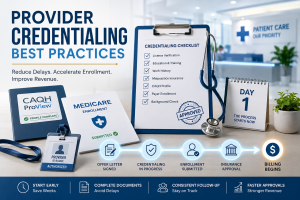




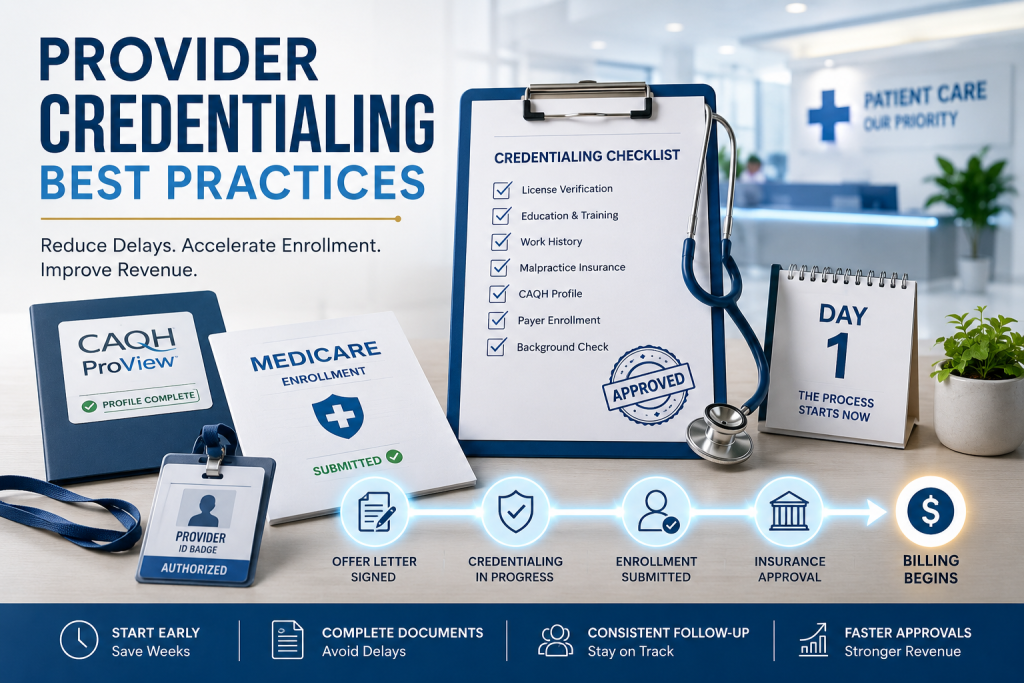
A new provider signs their offer letter, clears their background check, and shows up ready to see patients on day one , except they can’t bill for a single visit yet. Somewhere between the signature and the first paycheck, a stack of applications, verifications, and payer reviews has to move through a system that doesn’t care how excited everyone is to get started. This is the reality of provider credentialing and enrollment, and it’s one of the most underestimated risks to a healthcare practice’s revenue cycle.
Getting this right isn’t just paperwork hygiene. It’s the difference between a provider seeing patients and generating revenue from week one, or a practice absorbing months of delayed reimbursement while a new hire sits on the sidelines of the billing system.
Key Takeaways
- Credentialing and enrollment are related but distinct processes, and treating them as one step often causes delays.
- Clean, current documentation , especially your CAQH profile , prevents the majority of avoidable holdups.
- Starting early, ideally the moment an offer letter is signed, can shave weeks off the timeline.
- Outsourcing credentialing to a dedicated team is often more cost-effective than it looks on paper, once denied claims and idle provider time are factored in.
What Is Provider Credentialing, Exactly?
Credentialing is the process of verifying a provider’s qualifications: education, training, licensure, work history, and any disciplinary history. Enrollment is the separate step of registering that provider with specific payers , Medicare, Medicaid, and commercial insurance plans , so claims can actually be paid. Practices often use “credentialing” as shorthand for both, but understanding the split matters, because a provider can be fully credentialed and still unable to bill a payer they haven’t enrolled with yet.
This distinction is exactly why a structured approach to provider enrollment matters as much as the credentialing itself. Skipping ahead on one without finishing the other is a common source of denied claims.
Why Timelines Matter More Than Most Practices Expect
Delays here aren’t abstract. According to MGMA’s analysis of the credentialing process, it can take 90 to 180 days between submission of a provider’s application and final credential verification and approval. For a practice bringing on a new physician or nurse practitioner, that’s potentially half a year of a fully staffed, fully trained provider unable to generate reimbursable revenue through most payers.
You’ve probably felt this if you’ve ever managed onboarding: the provider is present, the schedule is filling up, and yet claims are piling up in a “pending credentialing” bucket that nobody wants to look at too closely.
The 5 Best Practices That Actually Move the Needle
Most credentialing advice repeats the same generic checklist. Here’s the version that focuses on what actually prevents delays:
- Start the moment the offer letter is signed. Don’t wait for a start date. Request licenses, diplomas, malpractice history, and work history documentation as soon as employment is confirmed.
- Build and maintain a clean CAQH profile first. Most commercial payers pull directly from CAQH ProView, so an outdated or incomplete profile creates a bottleneck that affects every application behind it.
- Submit Medicare enrollment early and separately. Since commercial payers often cross-reference PECOS data, getting Medicare enrollment moving first creates a clean foundation for everything downstream.
- Track every application with a single source of truth. A shared checklist or tracking system , not scattered emails , keeps submission dates, follow-ups, and missing documents visible to everyone involved.
- Follow up on a fixed schedule, not when something goes wrong. Regular check-ins with payers catch missing documents or stalled reviews before they add weeks to the timeline.
A Simple Framework for Reducing Delays
| Practice | When It Helps Most | A Simple Cue | Common Mistake |
| Early document collection | New provider onboarding | Request documents the day the offer is signed | Waiting until the start date to begin paperwork |
| CAQH profile accuracy | Before any payer submission | Re-attest every 120 days without exception | Letting the profile lapse or go stale |
| Medicare-first sequencing | Multi-payer enrollment | Submit PECOS application before commercial plans | Submitting commercial and Medicare applications out of sync |
| Centralized tracking | Practices onboarding multiple providers | One shared tracker for every application’s status | Relying on individual staff memory or scattered emails |
| Scheduled payer follow-up | Long-pending applications | Check in weekly, not only when a denial appears | Waiting passively for payers to respond |
What Should You Prepare Before You Even Start?
Here’s the direct answer: a complete, verified document package speeds up nearly every stage of both credentialing and enrollment. At minimum, that means:
- Current medical license(s) for every state where the provider will practice
- Diplomas and residency/training certificates
- Malpractice insurance details, including carrier, policy number, and coverage dates
- A complete, unbroken work history with no unexplained gaps
- NPI numbers (Type I and, where applicable, Type II)
- DEA registration, if relevant to the provider’s specialty
Gaps or inconsistencies in any of these are among the most common reasons applications get returned for correction, which resets the clock on an already long process.
Myths vs. Facts About Credentialing and Enrollment
Myth: “Credentialing and enrollment are the same process.” Fact: Credentialing verifies a provider’s qualifications; enrollment registers them with specific payers so claims can be reimbursed. A provider can be credentialed and still not enrolled with a given plan.
Myth: “Once CAQH is done, the process is basically finished.” Fact: CAQH completion is one input into payer review, not an approval itself. Commercial payers, Medicare, and Medicaid each still conduct their own separate review and approval process.
Myth: “Outsourcing credentialing is only worth it for large practices.” Fact: Smaller practices often lose more, proportionally, to delayed reimbursement and denied claims from in-house credentialing gaps than they would spend on a dedicated credentialing solution.
Do this, not that: Do treat credentialing as a parallel track that starts on day one of employment. Don’t treat it as a formality to handle after the provider already has a full patient schedule.
A Familiar Scenario
Picture a growing multi-specialty practice bringing on two new providers in the same month. The front office is focused on scheduling, onboarding, and EHR access , understandably so. Credentialing gets handed to whoever has time between other tasks, and CAQH profiles sit half-finished for weeks.
By the time applications go out, Medicare and three commercial payers are all moving on different timelines, with no single person tracking which payer is waiting on which document. Three months later, both providers are seeing full patient loads, but a growing stack of claims sits unpaid, waiting on enrollment that should have started the day their offer letters were signed. This is less a rare mishap than a pattern that shows up in practices without a dedicated credentialing solutions process , which is exactly the gap that a structured credentialing and enrollment partner is built to close.
Bringing It Together
As management theorist W. Edwards Deming put it, “If you can’t describe what you are doing as a process, you don’t know what you’re doing.” Credentialing and enrollment reward exactly that mindset , a defined process, tracked consistently, beats scrambling reactively every time. The practices that treat this as a structured workflow, starting the day an offer letter is signed, consistently see shorter timelines and fewer denied claims than those that treat it as an afterthought.
If your practice is bringing on new providers, or finding that credentialing keeps eating into staff time better spent elsewhere, it may be worth having a dedicated team handle it. Easy Billing Services’ credentialing solutions cover provider enrollment, CAQH setup and maintenance, licensing, NPI registration, and hospital privilege applications for all provider types in all states , built specifically to keep this process from becoming the bottleneck it so often is.
Ready to simplify your credentialing process? Contact Easy Billing Services today. Call (877) 306-2906 or email info@easybillingservices.com to learn how our credentialing solutions can help your practice avoid delays and get providers billing sooner.
Frequently Asked Questions
What’s the difference between credentialing and enrollment?
Credentialing verifies a provider’s education, licensure, and history. Enrollment is registering that provider with specific payers so their services can be billed and reimbursed.
How long does provider credentialing typically take?
Industry data points to a range of roughly 90 to 180 days from application submission to final approval, though timelines vary by payer and state.
What is CAQH, and why does it matter for credentialing?
CAQH ProView is a centralized database where providers maintain their professional information. Most commercial payers pull directly from it, so an outdated profile can delay every application tied to it.
Do Medicare and Medicaid credentialing timelines differ?
Yes. Medicare enrollment through PECOS generally moves on its own timeline, while Medicaid processing varies significantly by state depending on how much of the review is automated versus manual.
What documents are required for provider credentialing?
Typically: state medical license(s), diplomas and training certificates, malpractice insurance details, complete work history, NPI numbers, and DEA registration where applicable.
How often does a provider need to be re-credentialed?
Most payers require re-credentialing roughly every two to three years, along with periodic CAQH re-attestation, typically every 120 days.
Is outsourcing credentialing more cost-effective than hiring in-house staff?
It depends on practice size and volume, but many practices find that outsourcing reduces the hidden costs of denied claims and delayed provider start dates, even when the direct fees look comparable to an in-house hire.
What causes the most common credentialing delays?
Incomplete documentation, outdated CAQH profiles, mismatched provider information across applications, and lack of consistent follow-up with payers are the most frequent culprits.
How does Easy Billing Services help practices with credentialing and enrollment?
Easy Billing Services manages provider enrollment for all provider types across all states, including Medicare, Medicaid, and commercial insurance, along with CAQH setup and maintenance, NPI registration, and hospital privilege applications , giving practices one coordinated point of contact instead of a scattered, in-house process.
Can Easy Billing Services help with both new provider credentialing and revalidation?
Yes, Easy Billing Services supports both initial provider enrollment and ongoing Medicare and Medicaid revalidation, so practices don’t have to manage renewal deadlines separately from new provider onboarding.