




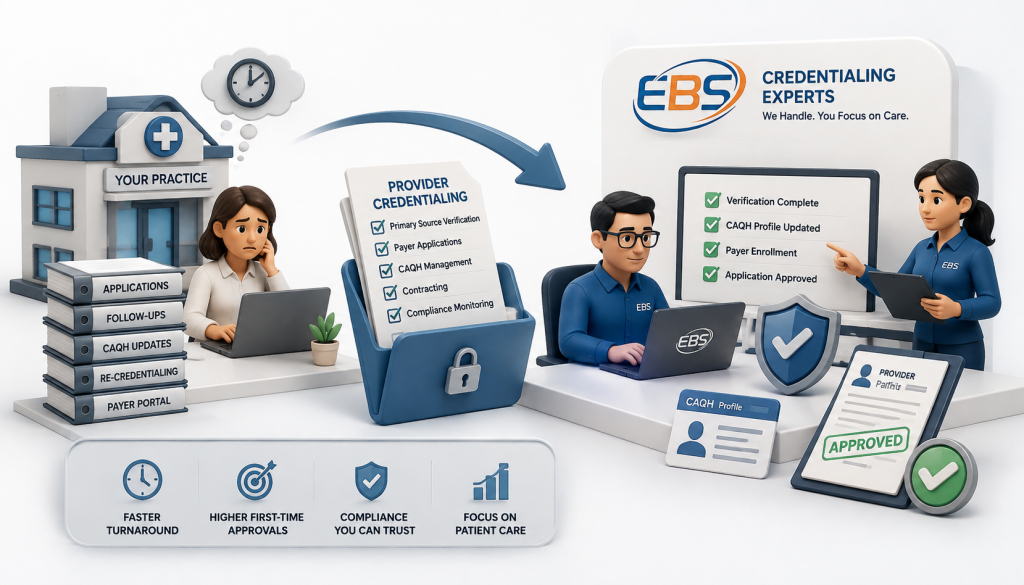
A hospital administrator once described her credentialing workload like juggling with one hand tied behind her back , fifteen providers, six payer panels each, and a spreadsheet that only she fully understood. When she went on medical leave for two weeks, three re-credentialing deadlines slipped through unnoticed. The fix wasn’t a better spreadsheet. It was recognizing that credentialing had outgrown what any single in-house employee could reliably manage alone.
That’s the exact realization driving more practices and hospitals to outsource credentialing services every year.
Key Takeaways
- Outsourcing credentialing means handing the entire verification and enrollment process to a specialized partner instead of managing it internally.
- Professional credentialing services can reduce credentialing turnaround time by 30% to 50% compared to in-house teams.
- First-time application approval rates with outsourced credentialing partners typically run 95% or higher, compared to 60% to 75% for in-house teams.
- Outsourcing works for solo providers, growing groups, and hospital systems alike , the scale changes, but the underlying benefit doesn’t.
What Does It Mean to Outsource Credentialing Services?
Outsourcing credentialing means partnering with a specialized company that handles the entire process on your behalf , primary source verification, payer applications, CAQH profile management, follow-up calls, and ongoing re-credentialing. Rather than managing every payer application internally, your practice hands that workload to a team that does this daily, across hundreds of providers and payer relationships.
This is different from simply buying credentialing software. A software platform gives you tracking tools, but someone still has to do the actual work of submitting applications and following up with payers. Full-service medical credentialing solutions include that labor, not just the dashboard.
Why Practices and Hospitals Are Outsourcing Credentialing
The case for outsourcing comes down to speed, accuracy, and freeing up internal staff for higher-value work:
- Faster turnaround. Professional credentialing services can reduce the time it takes to get a provider fully enrolled by 30% to 50% compared to handling it in-house, largely due to established payer relationships and dedicated staff focus. (source)
- Higher first-time approval rates. Outsourced credentialing partners typically achieve first-time approval rates of 95% or higher, compared to 60% to 75% for in-house teams , and every rejected application adds another 30 to 60 days of delay. (source)
- Reduced staffing risk. In-house credentialing depends heavily on one or two people knowing the process. When they’re out sick, on leave, or leave the job, the whole system can stall.
- Built-in compliance monitoring. Reputable credentialing partners track exclusion lists, license expirations, and re-attestation deadlines as a matter of routine, not an afterthought.
Who Actually Benefits From Outsourcing Credentialing?
Outsourcing isn’t just for large systems , it scales down just as well as it scales up:
- Solo and small practices often lack the staff bandwidth to track multiple payer applications and re-attestation deadlines correctly.
- Growing multi-provider groups need consistent, repeatable processes as they add providers, rather than reinventing the wheel with each new hire.
- Hospitals and health systems managing dozens or hundreds of providers need hospital credentialing services built for volume, with centralized tracking across every payer and every location.
- Practices combining billing and credentialing benefit from a single partner handling both, since enrollment gaps directly cause billing denials , which is exactly why medical billing and credentialing services are increasingly offered together rather than separately.
What’s Included in Full-Service Credentialing and Enrollment Services
| Service Component | What It Covers |
| Initial credentialing | Primary source verification, license checks, background and malpractice history review |
| Provider enrollment | Payer-specific applications for Medicare, Medicaid, and commercial insurers |
| CAQH management | Profile setup, ongoing attestation, and data accuracy checks |
| Contracting support | Negotiating and managing payer contracts as part of credentialing and contracting services |
| Compliance monitoring | Exclusion list checks, license expiration tracking, and re-credentialing scheduling |
| Status reporting | Regular updates so your team always knows where each application stands |
The Fastest Way to Get Professional Credentialing Services Set Up
- Take inventory of your current provider and payer mix, including any pending applications or upcoming re-credentialing deadlines.
- Decide how much you want to hand off , full-service outsourcing, a hybrid model, or targeted support for specific payers or specialties.
- Request a clear, written scope of work from any credentialing partner, so you know exactly what’s included before signing.
- Transfer existing documentation and CAQH access to avoid starting verification from scratch.
- Set a regular reporting cadence so your team always has visibility into application status, even though the day-to-day work is handled elsewhere.
Do This, Not That: Getting Outsourcing Right
- Do this: Get a written scope of work covering verification, enrollment, CAQH management, and reporting. Not that: Assume “credentialing services” means the same thing at every company.
- Do this: Ask about first-time approval rates and average turnaround time. Not that: Choose a partner based on price alone without checking performance history.
- Do this: Keep a designated internal contact for your credentialing partner, even after outsourcing. Not that: Assume outsourcing means zero internal involvement.
A Familiar Scenario: The Group Practice That Stopped Firefighting
Overview: A seven-provider multi-specialty group had one office manager handling credentialing alongside a dozen other responsibilities, using little more than a shared spreadsheet to track deadlines.
What happened:
- Two providers experienced multi-week billing gaps after re-credentialing deadlines were missed during a particularly busy quarter.
- The practice brought in a full-service credentialing partner to manage all active providers and payer relationships going forward.
- Within the first quarter, every provider’s status was current, and the practice had a clear, standing view of upcoming deadlines for the first time.
Insight: As Henry Ford once put it, “coming together is a beginning, staying together is progress, working together is success.” Outsourcing credentialing isn’t about giving up control , it’s about partnering with a team built specifically to keep the process moving.
Finding the Right Credentialing Partner for Your Practice
Among the many credentialing and enrollment services available, the right fit depends on your provider count, specialties, and payer mix. Easy Billing Services offers full credentialing solutions , including Medicare and Medicaid enrollment, CAQH management, commercial payer credentialing, contracting support, and DME-specific accreditation , built for solo practices, growing groups, and larger organizations alike.
Ready to hand off the paperwork? Call Easy Billing Services at (877) 306-2906 or email info@easybillingservices.com to talk through your credentialing needs.
Frequently Asked Questions
What does it mean to outsource credentialing services?
It means partnering with a specialized company to handle the full credentialing process , verification, payer applications, CAQH management, and ongoing compliance , instead of managing it with internal staff.
What are the best credentialing services for a growing practice?
The best fit depends on your provider count and payer mix, but look for a partner with strong first-time approval rates, transparent pricing, and experience with your specific specialties.
Is Easy Billing Services a hospital credentialing company, or just for smaller practices?
Easy Billing Services supports practices of every size, from solo providers to larger, multi-provider organizations with more complex payer and contracting needs.
What’s included in provider enrollment and credentialing services?
Typically primary source verification, payer-specific enrollment applications, CAQH profile management, contracting support, and ongoing compliance monitoring.
How is medical billing and credentialing services different from credentialing alone?
Combining both means the same partner manages provider enrollment and the billing process together, which helps prevent the revenue gaps that happen when enrollment and billing are handled separately.
What’s the fastest way to get professional credentialing services for a new hire?
Start the process as early as possible , ideally 90 to 120 days before a provider’s start date , and hand off documentation and CAQH access right away so verification isn’t delayed by missing paperwork.
Do outsourced credentialing companies handle re-credentialing too?
Yes, ongoing re-credentialing and compliance monitoring are typically included as part of full-service credentialing and enrollment services, not just the initial application.



Sau vài lần trải nghiệm 188v vip , mình thấy giao diện khá thân thiện. TONY08-10