




A new physician signs an offer letter, sets up an exam room, and expects to start seeing patients within a few weeks. Then the calendar quietly slips. Six weeks pass. Then ten. The provider is fully licensed, fully qualified, and still can’t bill a single insurance company.
This isn’t a rare hiccup. It’s the credentialing process for healthcare providers doing exactly what it’s designed to do , verify every credential, one payer at a time , just slower than most practices plan for.
Understanding how this process actually works, and where it typically stalls, is the difference between a provider who’s billing within two months and one who’s still waiting at month five.
Key Takeaways
- Credentialing verifies a provider’s qualifications; enrollment gets that provider paid by a specific payer , they’re related but not the same step.
- Most commercial payer credentialing takes 90 to 120 days when the application is complete and accurate.
- A single missing document or an outdated CAQH profile is the most common reason credentialing stretches past 150 days.
- A short pre-submission checklist prevents the majority of avoidable delays.
What Is the Credentialing Process for Healthcare Providers?
Credentialing is the process payers and healthcare organizations use to verify a provider’s education, training, licensure, work history, and malpractice record before allowing that provider to treat patients under their network or bill for services. It relies on primary source verification , confirming information directly with the issuing institution, not just accepting a copy of a diploma.
Provider enrollment is the next step: once credentials are verified, the provider applies to join a specific payer’s network so claims can actually be reimbursed. Practices often use “credentialing” as shorthand for both steps combined, which is part of why the timeline feels murky from the outside.
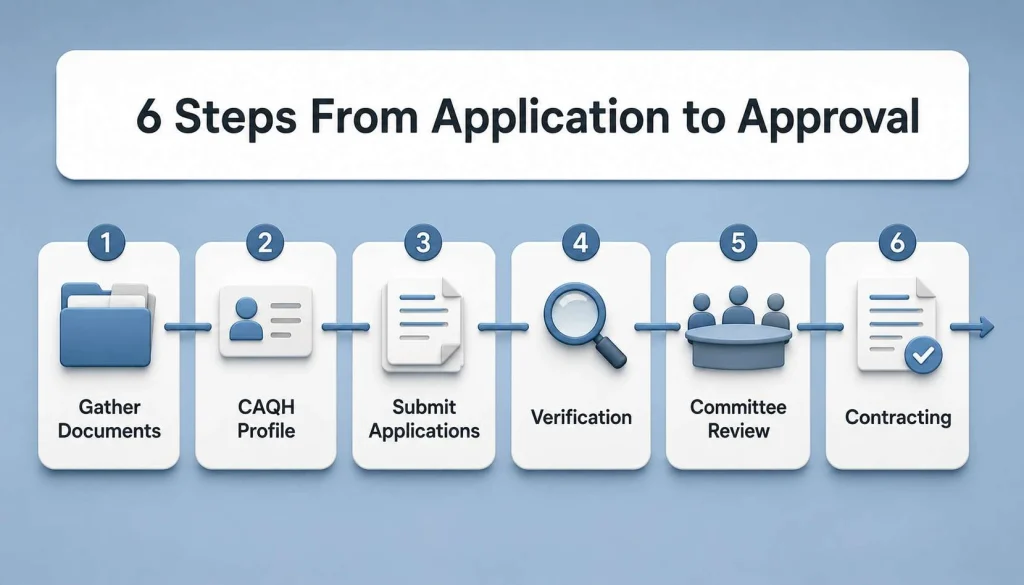
Medical Credentialing Steps, In Order
The provider credentialing process generally follows the same sequence regardless of specialty or payer:
- Gather core documents. Medical license, DEA registration, board certification, malpractice insurance, and a complete work history with no unexplained gaps.
- Build or update the CAQH profile. Most commercial payers pull directly from this centralized database rather than accepting separate paper applications.
- Submit payer-specific applications. Each insurance company reviews the CAQH data alongside any additional forms it requires.
- Primary source verification. The payer or its credentialing committee confirms education, licensure, and certifications directly with issuing institutions.
- Committee review and approval. A credentialing committee formally approves the provider for network participation.
- Contracting and effective date. The provider receives a network effective date, after which claims can be billed and paid.
This is the sequence most credentialing checklist resources circle back to, because skipping or rushing any single step is what pushes approval past the standard window.
How Long Does the Credentialing Timeline Actually Take?
Ask most practice managers, and they’ll say credentialing “takes about three to four months.” That’s a fair average, but it hides a wide range depending on the payer and how clean the application is.
Standard commercial payer credentialing generally runs 90 to 120 days once a complete CAQH profile and application are submitted. Medicare enrollment through PECOS often moves faster, typically 60 to 90 days. Medicaid varies significantly by state. And the National Committee for Quality Assurance, which accredits many payer credentialing programs, sets a 180-calendar-day verification time limit as the outer boundary organizations must work within. (NCQA, Credentialing and Provider Network Standards)
What pushes a file past that window almost always comes down to documentation, not the provider’s qualifications. A single missing signature, an unexplained employment gap, or a CAQH profile that hasn’t been attested in the last 120 days can each add weeks.
What Are the Medical Credentialing Requirements?
Every payer has its own application format, but the underlying medical credentialing requirements are consistent:
- Active, unrestricted state medical license
- National Provider Identifier (NPI)
- DEA registration, where applicable
- Board certification documentation
- Current malpractice insurance declaration
- Complete work history covering at least the past five years, with gaps explained
- Professional references
- Hospital privileges documentation, if applicable
Payers won’t begin substantive review until every required field is complete , a profile sitting at 95% complete is, functionally, not started.
| Document Type | Purpose | Who Provides It | Common Mistake |
| CAQH Profile | Central data source most payers pull from | Provider or credentialing staff | Incomplete sections or lapsed 120-day attestation |
| State License | Confirms active, unrestricted practice authority | State licensing board | Expired license uploaded instead of current one |
| Malpractice Insurance | Verifies current and historical coverage | Insurance carrier | Missing historical coverage years |
| Work History | Explains professional background, no unexplained gaps | Provider | Gaps over 90 days left unexplained |
| Board Certification | Confirms specialty qualification | Certifying board | Expiration date not tracked |
Physician Credentialing vs. Provider Enrollment: What’s the Difference?
Physician credentialing confirms a provider is qualified to practice. Provider enrollment is the separate process of joining a specific payer’s network so that provider’s claims get paid. A physician can be fully credentialed and still unable to bill a particular insurer until enrollment with that specific payer is complete.
This distinction matters because practices sometimes assume credentialing alone means a provider is ready to see insured patients. In reality, both steps need to finish, payer by payer, before billing can begin cleanly.
Insurance Credentialing Mistakes That Slow Everything Down
Most delays trace back to a short list of repeat mistakes.
Do this, not that:
- Do complete the CAQH profile to 100% before submitting payer applications. Not: submit early and assume the payer will follow up on gaps.
- Do explain every employment gap over 90 days with dates and context. Not: leave gaps blank and hope they go unnoticed.
- Do track re-attestation and license renewal dates on a calendar. Not: rely on payer email reminders alone.
- Do submit applications to priority payers in parallel. Not: wait for one approval before starting the next.
As Peter Drucker put it, “What gets measured gets managed” , and credentialing timelines are no exception. Practices that track each application’s status weekly close files faster than those that check in only when a provider asks why they still can’t bill.
A Familiar Scenario: The Six-Month Wait
Picture a family medicine practice bringing on a new physician in January, expecting to start billing by March. The provider’s CAQH profile looked complete at a glance, but one malpractice coverage year was missing from the documentation.
The payer didn’t flag it immediately , the application simply sat in a pending queue for weeks with no visible movement. By the time the gap was caught and corrected, the practice had lost nearly two additional months of billable revenue for that provider, on top of the original 90-day estimate.
This is one of the more common patterns in provider enrollment services: not a disqualifying issue, just a small documentation gap that went unnoticed until it had already cost real time.
Payer Enrollment Process: What Happens After Approval
Once a payer approves a provider, enrollment isn’t quite finished. The provider needs a confirmed network effective date, and any claims billed before that date typically won’t be paid, even if the approval letter has already arrived.
Tracking effective dates carefully , and holding claims until the date is confirmed , prevents a second, avoidable wave of denials right after a provider clears credentialing.
A Simple Credentialing Checklist
Before submitting any application, confirm:
- Is the CAQH profile 100% complete and attested within the last 120 days?
- Are all licenses, certifications, and malpractice documents current, not expired?
- Is the five-year work history complete with any gaps explained?
- Have priority payers been identified and applications submitted in parallel?
- Is there a tracking system for follow-up, re-attestation, and effective dates?
Five checks. A few minutes to review. It’s a small habit that prevents the majority of preventable delays.
Bringing It Together
The credentialing process for healthcare providers isn’t designed to be an obstacle course , it exists to confirm, with real verification, that every provider treating patients and billing payers is who and what they claim to be. When the CAQH profile, supporting documents, and payer applications are complete and consistent from the start, most files move through in the standard 90 to 120 day window instead of drifting past 150.
Managing this consistently across every new hire, every payer, and every re-attestation cycle is exactly the kind of ongoing work a dedicated credentialing partner handles well. Easy Billing Services LLC supports healthcare providers with hands-on credentialing services, from CAQH setup through payer enrollment, so new providers start billing sooner and existing ones stay active in-network without lapses. Reach the team at (877) 306-2906, email info@easybillingservices.com, or visit easybillingservices.com to talk through your current credentialing timeline.
Frequently Asked Questions
What is the credentialing process for healthcare providers? It’s the verification process payers and healthcare organizations use to confirm a provider’s education, licensure, training, and work history before allowing them to join a network or bill for services.
How long does the provider credentialing process take? Most commercial payers complete credentialing in 90 to 120 days with a complete application. Medicare enrollment often takes 60 to 90 days, while Medicaid timelines vary by state.
What are the basic medical credentialing steps? Gathering core documents, building a CAQH profile, submitting payer-specific applications, primary source verification, committee review, and finally contracting with a confirmed effective date.
What’s the difference between credentialing and provider enrollment? Credentialing verifies a provider’s qualifications. Enrollment is the separate process of joining a specific payer’s network so that payer will reimburse claims.
What causes the most delays in insurance credentialing? Incomplete CAQH profiles, unexplained work history gaps, and expired documents are the most common causes of delays past the standard 90 to 120 day window.
What is a typical credentialing checklist for new providers? A complete, attested CAQH profile, current licenses and malpractice coverage, a fully explained five-year work history, and applications submitted to priority payers in parallel.
Can a provider see patients before credentialing is complete? A provider can see patients once licensed, but claims typically can’t be billed to a payer until that payer’s enrollment and effective date are confirmed.
What credentialing requirements do most payers share? An active state license, NPI, DEA registration where applicable, board certification, current malpractice insurance, and a complete, gap-free work history.
What credentialing services does Easy Billing Services LLC provide? Easy Billing Services LLC handles CAQH profile setup, payer applications, primary source verification support, and ongoing re-attestation tracking so providers start billing faster and stay compliant.
Does Easy Billing Services LLC help with credentialing for new physicians joining a practice? Yes. The team manages new-provider credentialing and enrollment from document collection through payer approval, reducing the administrative burden on practice staff.




https://shorturl.fm/bygj2
Trước đây mình từng gặp lỗi ở vài nơi khác nhưng với 888slot link thì ít gặp hơn hẳn. TONY07-03
https://shorturl.fm/G7v3c