





Yes, a healthcare provider can handle their own credentialing.
There is generally no requirement that a physician, therapist, chiropractor, supplier or other eligible provider must hire an outside credentialing company to complete enrollment applications.
But being allowed to do it yourself does not necessarily make it the safest or most practical choice.
The forms are only one part of the work. Successful credentialing may also require selecting the correct enrollment type, matching information across multiple systems, submitting supporting documents, responding to payer requests, tracking application status and confirming the provider’s effective date before claims are submitted.
A small error may not result in an immediate denial. Instead, the application may remain pending, be returned for correction or reach approval with information that does not match the practice’s billing setup.
That is why DIY provider credentialing often becomes more difficult than expected.
Key Takeaways
- Providers can complete their own credentialing and enrollment applications.
- Credentialing, enrollment and payer contracting are related but different processes.
- Inconsistent information can delay an otherwise valid application.
- Approval does not always mean billing can begin immediately.
- Each payer may use different forms, portals and follow-up procedures.
- Credentialing requires ongoing maintenance after the initial approval.
- Professional support is most valuable when several payers, providers, states or locations are involved.
What Is Provider Credentialing?
Provider credentialing is the process used to review and verify a healthcare professional’s qualifications.
Depending on the organization, this may include verification of:
- Professional education
- Training and residency
- Active licenses
- Board certification
- Work history
- Malpractice insurance
- Claims history
- Sanctions or disciplinary actions
- Hospital privileges
- Professional references
- National Provider Identifier
- Practice locations
The purpose is to determine whether the provider meets the organization’s participation or privileging requirements.
However, the term “credentialing” is often used broadly to describe several different administrative processes.
Credentialing, Enrollment and Contracting Are Not the Same
Understanding the difference is essential before attempting the process yourself.
Credentialing
Credentialing verifies the provider’s professional qualifications and background.
Payer enrollment
Enrollment adds the provider or organization to a payer’s administrative and billing systems.
For Medicare, providers and suppliers may need to complete enrollment through PECOS or the appropriate paper application. CMS explains that PECOS allows providers to enroll, upload supporting documents, sign applications electronically and manage existing enrollment information. CMS also notes that PECOS applications generally process faster than paper submissions.
Contracting
Contracting establishes the terms under which the provider participates in a commercial insurance network.
The provider may need to review and sign a participation agreement before becoming in-network.
Privileging
Hospital privileging determines which procedures or services a provider is authorized to perform at a specific facility.
A provider can complete one stage without completing all the others.
For example, a payer may verify a provider’s credentials but still require contracting, system loading or group reassignment before claims can be paid correctly.
What Does the Provider Credentialing Process Include?
The exact process varies by payer, provider type and state, but it commonly includes the following stages.
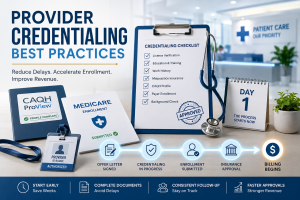
1. Preparing the provider’s information
Before applications begin, the provider should assemble a complete credentialing file.
Commonly requested information includes:
- Individual NPI
- Organization NPI, when applicable
- Tax identification number
- W-9
- State professional license
- DEA registration, when applicable
- Controlled-substance registration, where required
- Malpractice insurance certificate
- Curriculum vitae
- Education and training history
- Board-certification information
- Work history
- Hospital privileges
- Professional references
- Practice addresses
- Billing address
- Correspondence address
- Ownership information
- Banking or electronic-payment details
Missing one required item can prevent an application from being treated as complete.
2. Confirming the practice structure
The application must reflect how the provider will actually practice and bill.
Important questions include:
- Is the provider enrolling individually?
- Will services be billed under a group?
- Is a Type 2 organizational NPI required?
- Will benefits be reassigned to the group?
- Are there multiple practice locations?
- Is the provider working under more than one organization?
- Which tax identification number will appear on claims?
- Which specialty and taxonomy codes apply?
A provider may enter individually correct information that is still wrong for the intended billing arrangement.
3. Setting up and maintaining CAQH information
Many commercial payers use a centralized provider-data profile to obtain credentialing information.
The profile must remain complete and consistent with the payer application.
Common problems include:
- Old practice addresses
- Expired documents
- Missing employment history
- Unexplained work-history gaps
- Incorrect contact information
- Inconsistent malpractice coverage
- Incorrectly authorized health plans
- Incomplete attestations
Completing the profile once is not enough. It must be reviewed and maintained as provider information changes.
4. Choosing appropriate payers
Not every payer is equally relevant to every practice.
Before submitting applications, providers should consider:
- Patient population
- Specialty demand
- Geographic service area
- Payer network status
- Whether the panel is accepting providers
- Reimbursement arrangements
- Referral patterns
- Administrative requirements
- Whether the payer offers applicable products
Submitting an application does not guarantee network participation. A payer may have a closed panel or limited need for a particular specialty.
5. Completing payer applications
Medicare, Medicaid programs, commercial insurance companies, IPAs and HMOs may each use different application systems.
The information must be entered consistently across all applications.
Differences involving the provider’s legal name, NPI, tax ID, address, taxonomy or group relationship can create delays later in the process.
6. Supplying supporting documents
Payers may request additional documents after reviewing an application.
A request may involve:
- Updated license
- Current malpractice certificate
- Clarification of work history
- Ownership documents
- Group agreement
- W-9
- Voided check
- Admitting arrangements
- Collaborative agreement
- Explanation of an adverse event
- Additional location details
These requests often have deadlines. Missing the response window may cause the payer to close or return the application.
7. Primary-source verification
The credentialing organization may verify information directly with licensing boards, educational institutions, certification bodies and other authoritative sources.
A provider cannot speed up every part of this process.
However, incomplete or inconsistent information can cause the reviewer to stop and request clarification.
8. Committee review and approval
Some applications proceed through an internal credentialing committee or approval process.
Even when the provider meets the qualifications, the application may remain pending while the payer completes its internal review.
9. Contracting and system loading
Commercial payer approval may be followed by contract execution and administrative loading.
The provider should confirm:
- Participation status
- Contracted products
- Effective date
- Provider number
- Group affiliation
- Approved locations
- Directory listing
- Claims-submission information
A congratulatory email or signed contract should not automatically be treated as proof that every billing system is ready.
10. Ongoing maintenance and revalidation
Healthcare credentialing continues after initial approval.
Providers may need to update:
- Licenses
- Insurance certificates
- Practice locations
- Ownership
- Contact information
- Hospital privileges
- Tax information
- Group affiliations
- Banking details
Medicare and Medicaid enrollments may also require revalidation. Commercial payer records and provider directories must be maintained as information changes.
Is Provider Credentialing Hard?
The individual forms are not always difficult.
The difficulty comes from managing several connected systems without allowing information to conflict.
A provider may need to work with:
- NPPES
- PECOS
- State Medicaid portals
- Commercial payer portals
- CAQH
- Hospital systems
- Licensing boards
- Accreditation organizations
- Billing platforms
- Practice-management software
Each system may ask similar questions using different language.
For example, a provider’s service location, correspondence address, billing address and pay-to address may be different. Entering the same address everywhere for convenience can create problems if it does not reflect the actual arrangement.
The process also requires repeated follow-up. An application can remain pending even when the provider believes everything has been submitted.
Why DIY Provider Credentialing Often Goes Wrong
The wrong application is selected
Individual practitioners, group practices, facilities and suppliers may require different applications.
Submitting a technically complete but incorrect application can delay the process significantly.
The NPI and tax structure do not match
A Type 1 NPI identifies an individual provider. A Type 2 NPI identifies an organization.
Using the wrong NPI or tax ID combination can affect enrollment, reassignment and claims payment.
Information is inconsistent across systems
A payer may compare information from several sources.
Differences in names, addresses, dates or specialties can create questions even when the differences seem minor.
The practice applies before it is ready
Applications may require final information about:
- Practice location
- Phone number
- Malpractice coverage
- Banking
- Ownership
- Billing arrangement
- Group affiliation
Submitting too early can lead to repeated changes or an incomplete file.
Follow-up requests are missed
Payer messages may be sent by email, portal notification, fax or mail.
A provider focused on patient care may not see the request before the deadline passes.
Approval is confused with an effective date
A provider should not assume that services delivered during the application period will automatically be paid as in-network claims.
The effective date should be confirmed directly with the payer.
The application is approved under incorrect information
Approval is not always the end of the problem.
A provider may later discover that:
- The wrong address is listed
- The provider was linked to the wrong group
- A location was omitted
- The directory is inaccurate
- Claims are being sent under the wrong payer ID
- Reassignment was not completed
Correcting the problem after claims begin may take more time than preventing it during enrollment.
Can DIY Credentialing Delay Revenue?
Yes.
The greatest cost of a credentialing error may not be an application fee. It may be delayed or lost reimbursement.
Possible consequences include:
- Claims rejected because the provider is not loaded
- Claims denied for services before the effective date
- Out-of-network processing
- Incorrect group payment
- Missing electronic remittance
- Patients unable to find the provider in the directory
- Referral sources unable to confirm participation
- Repeated resubmission of enrollment information
Hiring a credentialing service does not control a payer’s internal review time.
It can, however, reduce preventable delays caused by incomplete applications, inconsistent information and missed follow-up requests.
When Can Doing Your Own Credentialing Make Sense?
DIY credentialing may be manageable when:
- There is only one provider
- The practice has a simple ownership structure
- Only one or two payer applications are needed
- The provider has finalized all practice information
- Documents are organized and current
- The provider understands NPI and group relationships
- Someone can monitor applications consistently
- The provider has time for repeated follow-up
- No unusual licensing, disciplinary or ownership issues exist
Even in a simple case, the provider should maintain a detailed application tracker.
It should include:
| Information to track | Why it matters |
| Payer and plan | One insurer may operate several networks |
| Application type | Individual, group, reassignment or facility |
| Submission date | Establishes when processing began |
| Confirmation number | Helps locate the application |
| Contact information | Supports consistent follow-up |
| Documents requested | Prevents missing items |
| Follow-up date | Keeps the application moving |
| Approval status | Records the current stage |
| Effective date | Determines when in-network billing may begin |
| Provider number | May be required for billing or status checks |
| Revalidation date | Helps maintain participation |
When Is Professional Credentialing the Better Choice?
Professional support becomes more valuable when:
- Several payers are involved
- The practice has multiple providers
- Providers work in several states
- Medicare and Medicaid enrollment are required
- The practice is adding a group or organization
- Multiple service locations are involved
- DMEPOS enrollment is required
- Hospital privileges are needed
- A payer application was previously denied or closed
- The provider has limited administrative staff
- A new practice must begin billing on a planned schedule
- Revalidation and ongoing maintenance are required
The issue is not whether the provider is capable of completing a form.
The issue is whether personally managing every portal, document request, deadline and follow-up is the best use of clinical or management time.
How Long Does It Take to Get Credentialed?
There is no universal credentialing timeline.
The process may take several weeks or several months depending on:
- Payer type
- Specialty
- State
- Panel availability
- Provider background
- Application completeness
- Document-verification speed
- Committee schedules
- Contract execution
- System loading
- Required site visits
- Response time to requests
Medicare, Medicaid and commercial payer applications also follow different processes.
Online submission may reduce mailing and data-entry delays, but it does not eliminate verification, contractor review or requests for additional information. CMS specifically encourages PECOS because it is paperless and generally processes faster than a paper Medicare application.
Providers planning a new practice should begin credentialing well before the expected opening or employment date.
They should not build revenue projections around the fastest possible approval.
How Can You Make Credentialing Move More Smoothly?
Before applying:
- Finalize the legal and billing structure.
- Confirm Type 1 and Type 2 NPIs.
- Verify the tax identification number and W-9.
- Organize licenses and certifications.
- Obtain current malpractice coverage.
- Prepare a complete work-history document.
- Confirm all practice locations.
- Make sure names and addresses match across systems.
- Determine which payers are accepting applications.
- Assign one person to track all follow-ups.
During processing:
- Check email and payer portals regularly
- Respond quickly to requests
- Record every call and reference number
- Save copies of submitted applications
- Confirm that documents were received
- Ask which stage the application has reached
- Verify the final effective date in writing
- Test claims and directory information after approval
What Does a Credentialing Service Handle?
A credentialing company may assist with:
- Initial document review
- NPI registration
- CAQH setup and maintenance
- Medicare enrollment through PECOS
- Medicaid enrollment
- Commercial payer enrollment
- IPA and HMO applications
- Provider revalidation
- Medical licensing
- Hospital privilege applications
- Primary-source verification
- Group and individual enrollment
- DMEPOS enrollment
- Application status follow-up
- Provider-data maintenance
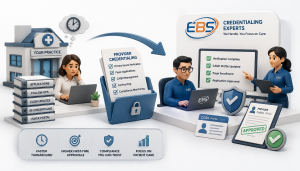
Easy Billing Services offers credentialing solutions for provider enrollment across states, including Medicare, Medicaid, commercial insurance, IPAs, HMOs, revalidation, CAQH maintenance, NPI registration, medical licensing, hospital privileges and DME-related enrollment support.
The provider still needs to supply accurate information and review documents requiring personal certification or signature. Outsourcing manages the process; it does not remove the provider’s responsibility for the truthfulness of the application.
Can a Credentialing Company Guarantee Approval?
No responsible credentialing company should guarantee approval by a payer or hospital.
Final decisions may depend on:
- Panel availability
- Provider qualifications
- Specialty demand
- Licensing status
- Background verification
- Payer policy
- Geographic need
- Contract terms
- Regulatory requirements
The practical value of professional credentialing is accurate preparation, organized submission, consistent follow-up and clearer status tracking.
It reduces controllable errors but cannot control the payer’s final decision.
Conclusion
So, can I do my own credentialing?
Yes. A provider can complete their own applications, gather documents and follow up with payers.
For a simple solo practice applying to a limited number of plans, DIY credentialing may be manageable.
But the process becomes much harder when it involves multiple payers, group enrollment, Medicaid, Medicare, several locations, DMEPOS, hospital privileges or ongoing revalidation.
Credentialing is not only about filling out forms. It requires correct sequencing, consistent data, supporting documentation, follow-up and confirmation that the provider has been loaded under the correct effective date and billing arrangement.
A provider who has enough time, administrative knowledge and a reliable tracking process may complete it independently.
A provider who wants to focus on patient careor who cannot afford preventable enrollment and revenue delaysmay find professional credentialing support to be the safer operational decision.
Frequently Asked Questions
Can I do my own credentialing?
Yes. Providers can complete their own credentialing and enrollment applications. The process requires accurate information, organized documents, payer-specific applications and consistent follow-up.
Is provider credentialing hard?
The forms may be manageable, but coordinating multiple portals, payer requirements, effective dates and document requests can be difficult.
What is the provider credentialing process?
It generally includes document preparation, profile setup, payer applications, primary-source verification, committee review, contracting, system loading and ongoing maintenance.
What documents are needed for healthcare credentialing?
Common documents include licenses, NPIs, tax information, W-9, malpractice insurance, work history, education, board certification and practice-location details.
Do I need CAQH to get credentialed?
Many commercial insurers use centralized provider-data profiles, but requirements vary by payer. Medicare enrollment uses PECOS rather than CAQH.
Can I start billing while credentialing is pending?
Do not assume pending applications allow in-network billing. Confirm the payer’s rules and the approved effective date before submitting claims as an in-network provider.
How long does it take to get credentialed?
It may take several weeks to several months. Timing depends on the payer, application completeness, verification, panel status and internal review.
Does hiring a credentialing company make approval faster?
It cannot control the payer’s processing time, but it may prevent avoidable delays caused by errors, missing documents and missed follow-ups.
Can a payer reject a complete application?
Yes. A payer may have a closed network, limited specialty need or other participation requirements.
What is the difference between credentialing and enrollment?
Credentialing verifies qualifications. Enrollment adds the provider to the payer’s administrative and claims systems. Contracting establishes network participation terms.
Do I need both a Type 1 and Type 2 NPI?
An individual provider uses a Type 1 NPI. A practice billing as an organization may also require a Type 2 NPI, depending on its structure.
What happens if my CAQH information is outdated?
The payer may request corrections, delay review or be unable to verify the provider’s current practice and documents.
How long does it take to get a credentialing certification?
Provider credentialing is not a certification awarded to the provider. It is a verification and enrollment process. Professional certifications for people working as credentialing specialists are separate and follow the eligibility and examination rules of the issuing organization.
Does credentialing need to be renewed?
Yes. Licenses, insurance, practice information and payer records must be maintained. Medicare and Medicaid may also require formal revalidation.
When should I outsource provider credentialing?
Consider outsourcing when several payers, providers, states, locations, government programs or DME-related requirements are involved.



Sending this to a couple of people! A former coworker pointed me to https://pllr.wnsr-zh.com/ a while back — it’s a job listings site that actually respects your time. Rather than checking a dozen sites, it’s all in one clean feed. Take care!