




Imagine two clinics hiring their first nurse practitioner in the same month. One clinic picks a credentialing partner based on a fast phone call and a low quote. The other spends an extra week asking the right questions before signing anything. Ninety days later, one provider is seeing insured patients and generating revenue. The other is still stuck in a payer queue, and nobody can explain why.
That gap didn’t come down to luck. It came down to how each clinic selected its credentialing company.
Choosing a credentialing partner feels like a back-office decision, but it behaves like a revenue decision. The right company gets providers approved and billing sooner. The wrong one creates delays that are hard to trace and even harder to fix once they’ve already cost you weeks of reimbursement.
Key Takeaways
- The best credentialing company isn’t always the cheapest or the fastest-talking one , it’s the one with a documented, compliant process.
- NCQA accreditation or certification is one of the clearest signals that a company follows a verified, audited process.
- Communication style matters almost as much as technical skill, since credentialing depends on constant payer follow-up.
- A good partner will tell you exactly what they need from you and when , a vague onboarding process is an early warning sign.
Why the Credentialing Company You Pick Actually Matters
Credentialing determines when a provider can start billing insurance. Pick a company that’s disorganized, slow to communicate, or unfamiliar with your specialty, and every one of those problems becomes your practice’s problem , usually in the form of delayed reimbursements and frustrated new hires.
It also matters more than it used to. Credentialing oversight tightened significantly in 2025, when the National Committee for Quality Assurance (NCQA) shortened its primary source verification window from 180 days to 120 days for accredited organizations, and to 90 days for certified ones, specifically to keep provider data current and get practitioners into networks faster. A credentialing partner that hasn’t adjusted its workflow to these tighter standards is already operating behind the current bar. (source)
What Actually Separates a Good Credentialing Company From a Mediocre One
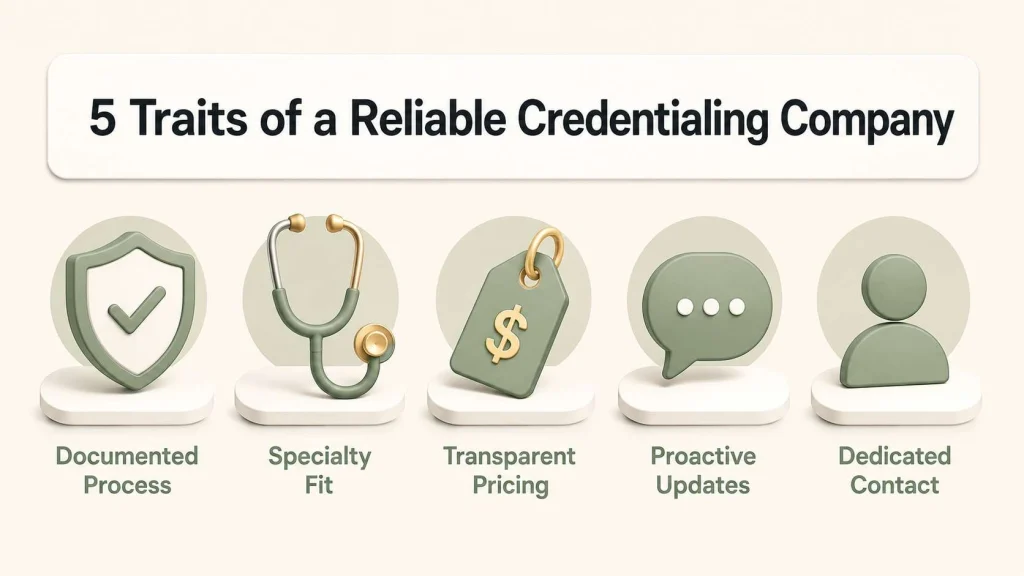
A credentialing company’s job sounds simple: verify a provider’s qualifications and get them approved with payers. In practice, that job involves dozens of moving pieces , CAQH profile management, payer-specific application requirements, primary source verification, and relentless follow-up. The companies that do it well share a handful of traits that are easy to check for before you sign anything.
- A documented, auditable process. NCQA accreditation or certification isn’t mandatory, but it’s strong evidence the company follows a verified, monitored workflow rather than an informal one.
- Specialty familiarity. A company experienced with your specialty already knows which payers ask for extra documentation and how to avoid the resubmissions that slow everything down.
- Transparent pricing structure. Flat, itemized fees are easier to budget around than vague packages with unclear add-ons.
- Proactive communication. The best partners update you before you have to ask, not after.
- A dedicated point of contact. A named account manager tends to catch problems faster than a shared inbox ever will.
In-House Team, Software Platform, or Full-Service Company: How Do They Compare?
(Figures below are general guidance for planning purposes; actual fit depends on your practice size and growth pace.)
| Approach | What You Get | Best Fit For | Watch Out For |
| In-house credentialing staff | Full control, direct oversight | Larger groups hiring providers regularly | Salary, training, and turnover costs |
| Credentialing software only | Tracking dashboards and reminders | Practices that already have staff to do the work | Software still requires someone to execute the process |
| Full-service credentialing company | End-to-end handling, from documents to payer approval | Growing practices, multi-payer panels, DME and Medicare enrollment | Confirm exactly what’s included before signing |
| Delegated / NCQA-certified CVO | Verified process aligned to national standards | Organizations that need audit-ready compliance | Fewer providers offer true delegated credentialing |
Is a Slower, Cheaper Option Ever the Right Call?
Sometimes. A solo provider joining two payers with plenty of admin time might not need a full-service partner. But as soon as a practice is hiring regularly, working across several payers, or managing Medicare, Medicaid, and commercial credentialing at once, the value of a documented, accountable process starts to outweigh the appeal of the lowest quote.
As Warren Buffett once put it, “it takes 20 years to build a reputation and five minutes to ruin it” , and few processes put a practice’s reputation and cash flow at risk faster than an unreliable credentialing partner. Choosing based on trust and track record, not just price, tends to hold up better over time.
The Five-Question Framework for Vetting Any Credentialing Company
Before signing with any credentialing partner, ask these five questions directly:
- Are you NCQA accredited or certified, and for which credentialing elements?
- How many years of experience do you have with my specific specialty and payer mix?
- What is your average turnaround time, and what happens if a payer misses a deadline?
- What exactly is included in your fee, and what would trigger an additional charge?
- Who will be my direct point of contact, and how often will I receive status updates?
A Simple Checklist for Comparing Your Top Two or Three Options
- Confirm NCQA accreditation or certification status and what it covers.
- Ask for references from practices in your specialty.
- Request a sample timeline for your specific payer mix.
- Get the full fee structure in writing, including renewal and re-credentialing costs.
- Clarify who owns the CAQH profile and documentation if you ever switch providers.
Do This, Not That: Common Mistakes When Choosing a Credentialing Partner
- Do this: Ask for a written timeline specific to your payer mix. Not that: Accept a vague “it depends” with no follow-up estimate.
- Do this: Check whether the company has handled your specialty before. Not that: Assume every credentialing company handles every specialty the same way.
- Do this: Get the fee structure in writing, including re-credentialing costs. Not that: Sign based on a verbal quote alone.
- Do this: Ask who owns your CAQH profile and documentation. Not that: Assume you can easily switch providers later without any transition friction.
A Familiar Scenario: The Clinic That Switched Credentialing Partners Mid-Process
Overview: A three-provider clinic hired a credentialing company based on the lowest quote they received, without checking accreditation status or asking for specialty references.
What happened:
- Applications for two commercial payers were submitted with outdated CAQH information, triggering rejections.
- The clinic had no dedicated contact, so status updates only came when someone called to ask.
- After six weeks with no clear progress, the clinic requested all documentation to switch providers.
The turnaround:
- The new credentialing partner reviewed and corrected the CAQH profile before resubmitting anything.
- A single point of contact provided weekly status updates without being asked.
- All three providers were fully approved within eight weeks of the switch.
Insight: The lowest quote wasn’t actually the cheapest option once six weeks of stalled revenue were factored in , the clinic paid for the switch, but paid far more for the delay that made it necessary.
Making the Final Call
Selecting a credentialing company comes down to matching your practice’s size, specialty, and growth pace with a partner that has a documented process, relevant experience, and communication you can count on. Price matters, but it shouldn’t be the deciding factor on its own , a slightly higher fee from a reliable, NCQA-aligned partner is almost always cheaper than months of stalled reimbursements from an unreliable one.
For practices weighing this decision, Easy Billing Services offers full credentialing solutions covering Medicare and Medicaid enrollment through PECOS, commercial payer credentialing, CAQH setup and attestation, NPI registration, hospital privilege applications, and DME-specific accreditation , all handled with a dedicated team rather than a rotating inbox.
Before your next hire starts the clock, it’s worth confirming exactly who will be handling their credentialing and how.
Ready to talk through your options? Call Easy Billing Services at (877) 306-2906 or email info@easybillingservices.com for a straightforward conversation about your practice’s credentialing needs.
Frequently Asked Questions
How can Easy Billing Services help me choose the right credentialing approach? Easy Billing Services works directly with practices to handle Medicare, Medicaid, commercial payer, and DME credentialing, offering a dedicated team and clear, itemized pricing so you know exactly what’s included from the start.
Does Easy Billing Services handle credentialing for specialties beyond DME? Yes. Their team supports provider enrollment, CAQH management, NPI registration, and hospital privileging across a range of specialties and provider types, not only DME.
How do I select the best credentialing company for my practice? Look for NCQA accreditation or certification, direct experience with your specialty, a transparent and itemized fee structure, and a dedicated point of contact who provides regular updates.
Is NCQA accreditation necessary for a credentialing company? It isn’t legally required, but it’s one of the clearest signs a company follows a documented, monitored, and audited process rather than an informal one.
What questions should I ask before hiring a credentialing company? Ask about accreditation status, specialty experience, average turnaround time, exactly what’s included in the fee, and who your direct point of contact will be.
Should I choose the cheapest credentialing company available? Not automatically. A lower fee can come with slower turnaround or less oversight, and the resulting delays often cost more than the difference in price.
Can I switch credentialing companies if I’m not satisfied? Yes, though it’s easier if you clarify upfront who owns your CAQH profile and documentation, so a transition doesn’t create additional delays.
What’s the difference between a credentialing company and credentialing software? Software provides tracking and reminders, but someone still has to complete the applications and follow up with payers. A full-service company handles both the process and the follow-up.
How long should credentialing take once I select a company? Timelines vary by payer and specialty, but a reliable partner should be able to give you a written estimate specific to your payer mix before you sign.



https://shorturl.fm/ERZU1
https://shorturl.fm/KJKXJ
https://shorturl.fm/5IJuA
https://shorturl.fm/2MhGp
https://shorturl.fm/we7wt
https://shorturl.fm/AmTLc
https://shorturl.fm/Dntr4
https://shorturl.fm/1RRKJ
https://shorturl.fm/zRPWE
https://shorturl.fm/nLWTO