





Picture a nurse practitioner who just joined a busy family practice. Her license is active. Her malpractice coverage is signed. Her schedule is already filling up. But two months later, she’s still seeing only a trickle of patients, because her insurance paperwork hasn’t cleared yet. Every day she waits, real revenue quietly walks out the door.
That’s the hidden weight behind one deceptively simple question: how much does credentialing cost?
It sounds like it should have a one-line answer. It doesn’t. The number depends on how many payers you’re joining, what kind of provider you’re credentialing, and whether you handle the paperwork yourself or hand it to someone who does this every day. But once you understand the moving parts, the cost stops feeling like a mystery and starts feeling like something you can actually plan for.
Key Takeaways
- Credentialing with a single payer usually costs a few hundred dollars per provider when you use a professional service.
- Once you add every commercial payer, Medicare, and Medicaid, most practices land somewhere between $2,000 and $5,000 per provider in the first year.
- Doing it yourself looks free on paper, but it eats dozens of staff hours that carry a real dollar value.
- The biggest cost isn’t the paperwork fee ,it’s the revenue lost while a provider waits to be approved.
What Credentialing Actually Is (In Plain Terms)
Credentialing is the process of proving a provider is who they say they are and qualified to do the job. Insurance companies, hospitals, and government programs verify a provider’s education, licenses, work history, and malpractice record before they’ll allow that provider to bill them. No credentialing, no reimbursement ,it’s really that direct.
Behind that one-sentence definition sits a stack of paperwork: CAQH profile setup, license verification, background checks, malpractice history, and a separate application for every single payer a provider wants to join. Multiply that by however many insurance panels your practice works with, and you can start to see why the cost question doesn’t have a flat answer.
How Much Does Credentialing Cost?
For a single provider joining a single insurance payer, professional credentialing services typically charge between $200 and $500. That fee covers gathering documentation, submitting the application, and following up until the provider is approved. Add every payer a provider needs ,several commercial plans plus Medicare and Medicaid ,and most practices end up spending somewhere between $2,000 and $5,000 per provider in the first year, once setup fees, CAQH management, and follow-up work are included.
That range moves depending on three things: how many payers you’re enrolling with, how complex the provider’s specialty is, and whether a practice handles the process in-house or brings in outside help. A solo behavioral health provider joining three payers pays very differently than a multi-specialty group onboarding five new physicians at once.
What Pushes Credentialing Costs Higher or Lower?
A few variables explain almost all of the swing between a modest bill and an expensive one:
- Number of payer panels. Each commercial insurer, plus Medicare and Medicaid, requires its own separate application and its own fee.
- Provider type and specialty. Behavioral health, facility-based, and multi-state providers often need extra documentation that adds time and cost.
- State requirements. Some states process applications quickly; others add layers of paperwork that stretch out staff hours.
- Timeline pressure. Rushing an application rarely lowers the price ,it usually raises it, since expedited handling and error correction both take extra effort.
- Who does the work. In-house staff time has a real cost even when no invoice is attached to it.
A Quick Look at Typical Costs by Approach
(Figures below are general ranges for planning purposes; your actual cost will depend on your state, specialty, and payer mix.)
| Approach | Typical Cost Range | Best Fit For | Where Costs Sneak Up |
| Handling it yourself | Staff time worth roughly $750–$1,500+ per provider, plus payer fees | Very small practices with spare admin hours | Missed deadlines and resubmissions |
| Professional credentialing service | Roughly $200–$500 per payer, or $2,000–$3,000+ per year per provider for full service | Growing practices with multiple payers | Setup fees and ongoing CAQH upkeep |
| Full-time in-house specialist | $50,000–$80,000+ in annual salary and benefits | Larger groups hiring providers regularly | Turnover, training, and slow seasons with underused staff |
| Hospital privileging | $500–$1,500+ per provider, separate from payer enrollment | Providers who need hospital privileges | Assuming it’s bundled into payer credentialing when it isn’t |
In-House vs. Outsourced Credentialing: Which One Actually Costs More?
On paper, doing credentialing in-house looks like the cheaper option, because there’s no vendor invoice. In practice, a single application can take four to eight hours to complete correctly, and a provider joining five or more payers can easily consume 20-plus staff hours between paperwork, follow-up calls, and fixing small errors that trigger a rejection. Multiply that by an office manager’s hourly rate, and the “free” option often costs more than a flat-fee service ,without the benefit of someone who already knows exactly what each payer wants to see.
Outsourcing shifts that cost from unpredictable staff hours into a fixed, plannable number. It also tends to shorten the waiting period, which matters more than most owners expect. As Benjamin Franklin put it, “By failing to prepare, you are preparing to fail” ,and few processes reward preparation the way credentialing does.
The Four Levers That Really Control Your Credentialing Bill
Instead of thinking of credentialing as one flat fee, it helps to think of it as four levers you can actually pull:
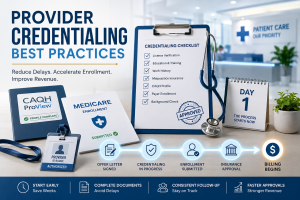
- Timeline. Starting 90 to 120 days before a provider’s start date almost always costs less than rushing.
- Payer count. Every additional panel is another application, another fee, and another follow-up chain.
- Documentation readiness. A provider with an up-to-date CAQH profile and organized paperwork moves faster and cheaper than one starting from scratch.
- Who does the work. In-house time, a dedicated hire, or an outside service each carry a different cost structure ,and a different amount of your own attention required.
A Simple Way to Budget for Credentialing Before You’re Surprised by It
- List every payer panel you’ll need this year, including Medicare and Medicaid.
- Get an exact per-payer fee in writing, not a rough guess.
- Add a realistic time cost if staff will be doing the work themselves.
- Build in the cost of re-credentialing two to three years out ,it isn’t a one-time expense.
- Compare that full total against a flat-fee professional quote before deciding which route to take.
Do This, Not That: Mistakes That Quietly Inflate the Bill
- Do this: Start the credentialing process 90 to 120 days before a provider’s start date. Not that: Wait until the hire date and treat credentialing as an afterthought.
- Do this: Keep CAQH profiles current with regular attestation. Not that: Let a profile lapse and force a re-verification from scratch.
- Do this: Ask vendors for a flat, itemized quote. Not that: Agree to open-ended hourly billing with no cap.
- Do this: Treat re-credentialing as a recurring line item. Not that: Assume credentialing is a one-time cost you’ll never see again.
The cost of getting this wrong is bigger than most practices expect. According to the Medical Group Management Association, a 2019 Merritt Hawkins survey found that a one-day delay in provider onboarding can cost a medical group over $10,000 ,a reminder that the real expense of credentialing usually isn’t the application fee at all. It’s the revenue that never gets billed while paperwork sits in a queue. (source)
A Familiar Scenario: The New Provider Who Almost Cost Two Months of Revenue
Overview: A small multi-provider clinic hired a new physician assistant, expecting her to start seeing patients within two weeks of her official hire date. Nobody had started the payer applications until her first day.
What happened:
- Commercial payer applications sat incomplete because the CAQH profile hadn’t been attested in over a year.
- Follow-up calls fell to whoever had a free hour, so nothing moved quickly.
- The physician assistant saw only a handful of self-pay patients for nearly eight weeks.
The turnaround:
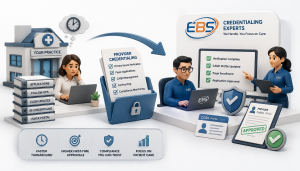
- The practice brought in outside credentialing support to take over every open application.
- All payer submissions were consolidated, tracked, and followed up on a set schedule.
- Full approval across every major payer landed within roughly six weeks of handing it off.
Insight: The clinic didn’t pay more for credentialing help ,it paid for the two months of lost billing that happened before it asked for help.
Is Paying for Professional Credentialing Support Worth It?
For a solo provider joining two or three payers, doing it yourself might genuinely make sense. But for practices onboarding providers regularly, working across multiple payer panels, or managing Medicare, Medicaid, and DME enrollment at the same time, the math tends to favor outside support ,not because it’s cheaper on the invoice, but because it protects the revenue that would otherwise sit in limbo.
That’s the exact gap Easy Billing Services was built to close. Beyond DME and Medicare billing, their team handles Medicare, Medicaid, and commercial provider enrollment, CAQH setup and attestation, NPI registration, hospital privilege applications, and full credentialing solutions for practices of every size ,so providers spend fewer weeks waiting and more weeks earning.
Credentialing costs will always vary by payer, specialty, and state, and providers should confirm exact fees and timelines directly with each payer or credentialing partner before budgeting a final number. If your practice is facing a growing backlog of applications or an upcoming hire, it’s worth getting a straight answer sooner rather than later.
Ready to stop guessing what credentialing will cost you? Call Easy Billing Services at (877) 306-2906 or email info@easybillingservices.com for a clear, no-surprises estimate.
Frequently Asked Questions
How can Easy Billing Services help lower my credentialing costs? Easy Billing Services manages the full application, follow-up, and CAQH maintenance process for you, which reduces the staff hours and resubmissions that usually drive costs up in the first place.
Does Easy Billing Services handle credentialing for DME and Medicare providers? Yes. Their team supports Medicare enrollment through PECOS, Medicaid enrollment in all states, commercial payer credentialing, and DME-specific setup and accreditation.
How much does credentialing cost overall? Most practices spend between $2,000 and $5,000 per provider in the first year once every payer application, CAQH setup, and follow-up work is included, though a single-payer application alone can run as low as $200 to $500.
Why do credentialing costs vary so much between practices? The number of payer panels, the provider’s specialty, state-specific requirements, and whether the work is done in-house or outsourced all shift the total up or down.
Is it cheaper to handle credentialing in-house or outsource it? In-house work looks cheaper because there’s no invoice, but the staff hours it consumes carry a real cost. Outsourcing turns that unpredictable time cost into one flat, plannable fee.
How often will I need to pay for re-credentialing? Most payers require re-credentialing every two to three years, so it’s a recurring cost rather than a one-time expense.
What hidden costs should I budget for beyond the application fee? Plan for CAQH maintenance, staff time for follow-up calls, potential resubmission delays, and the revenue lost while a provider waits to be approved.
Can a solo provider negotiate credentialing costs? Sometimes. It’s worth asking directly, especially when bundling credentialing with other billing services, since many providers offer package pricing.
Does a faster credentialing timeline cost more? Rushing rarely lowers the price and often raises it. Starting the process 90 to 120 days ahead of a provider’s start date is usually the more affordable path.



https://shorturl.fm/ajRhL
https://shorturl.fm/axFZT
Chơi giải trí tại cricify tv download khá vui và không bị nhàm chán. TONY08-10