



How Does DME Billing Work? From Coding to Claim Payment

A wheelchair goes out the door. A hospital bed gets delivered. A CPAP machine gets set up in someone’s bedroom. That’s the easy part. What happens next , the coding, the documentation, the claim, the wait , decides whether your business gets paid or gets a denial letter three weeks later. That’s the DME billing process, and it’s where most equipment suppliers actually lose money, not on the equipment itself. This guide walks through how DME billing works, start to finish: from HCPCS coding through claim submission, payer review, and final payment. No jargon dump , just the real sequence, the common failure points, and what separates a clean claim from a denied one. Key takeaways: DME billing runs on HCPCS Level II codes, not standard CPT codes , get the code wrong and the claim stalls before it’s even reviewed. Documentation, not the equipment itself, is the leading cause of DME claim denials. A Certificate of Medical Necessity or supporting clinical note is often what separates a paid claim from a denied one. Most delays trace back to missing proof of delivery or an incomplete physician order, not payer error. What Actually Happens During the DME Claims Process? The DME billing process moves through five stages: intake and verification, coding, claim submission, payer adjudication, and payment or denial. Each stage depends on the one before it. Skip a step in documentation and the claim can fail two stages later, when it’s much harder to fix. Here’s the honest version: DME billing isn’t one task. It’s a chain, and one weak link changes the outcome for the whole claim. Step 1: Eligibility and Documentation Intake Before any code is entered, the billing team confirms the patient’s insurance coverage, checks whether the equipment needs prior authorization, and collects the paperwork Medicare or the payer requires. That usually means: A valid physician’s order or prescription A Certificate of Medical Necessity (CMN) for certain equipment categories Clinical notes supporting why the equipment is medically necessary Patient and payer identification details Missing any one of these doesn’t just slow the claim down. It gives the payer a documented reason to deny it later. Step 2: HCPCS Coding , Where Precision Matters Most This is the step that separates DME billing from general medical billing. Instead of CPT codes, DME uses HCPCS Level II codes (think codes like E0143 for a walker or E0601 for a CPAP device), plus modifiers that describe how the equipment was provided , rented, purchased, new, or used. Modifiers like RR (rental), KH (initial setup), and KX (documentation on file) aren’t optional extras. They tell the payer exactly what’s being billed and confirm the required paperwork exists. Get the modifier wrong, and a correctly coded item can still be denied. Step 3: Claim Submission Once coding is complete, the claim is submitted electronically to the correct payer , Medicare, Medicaid, or a commercial insurer , along with the supporting documentation. Suppliers working with Medicare submit through their regional DME Medicare Administrative Contractor (DME MAC), not a general Part B contractor. Step 4: Adjudication (Payer Review) The payer reviews the claim against coverage policy, medical necessity criteria, and documentation completeness. This is where most denials originate , not because the equipment wasn’t needed, but because the file supporting it was incomplete. Step 5: Payment, Denial, or Appeal A clean claim gets paid on the payer’s standard cycle. A flagged claim comes back with a denial code, and the supplier has a limited window to correct and resubmit or file a formal appeal with additional documentation. The Framework: The 3-Document Rule If you remember nothing else from this guide, remember this: every DME claim needs three documents present before it’s ever coded the physician’s order, proof of medical necessity, and proof of delivery. Missing any one of these is the single most predictable reason a claim comes back denied. Coders can be flawless and the claim will still fail without these three in the file. Where DME Claims Actually Get Denied (And What Most People Get Wrong) According to CMS’s own published data on ventilator claims, insufficient documentation accounted for 66.5% of improper payments for ventilators during the 2024 reporting period, while missing documentation and other errors made up the rest. That pattern holds across most DME categories it’s rarely the equipment that’s the problem. It’s the paper trail behind it. cms Common mistakes: Do this: Confirm the CMN is signed and dated before submission. Not this: Submit and plan to send the CMN “if requested.” Do this: Match the HCPCS code to the exact equipment delivered. Not this: Use a close-enough code because the exact one wasn’t obvious. Do this: Keep signed proof of delivery on file for every item. Not this: Assume a verbal confirmation from the patient is sufficient. DME Billing vs. Standard Medical Billing Factor DME Billing Standard Medical Billing Coding system HCPCS Level II + modifiers CPT / ICD-10 Key requirement Certificate of Medical Necessity, proof of delivery Clinical documentation of service rendered Common denial cause Missing/incomplete documentation Coding mismatch, eligibility issues Reimbursement timeline Often longer due to prior authorization Typically shorter cycle A Realistic Scenario Picture a supplier who delivers a power wheelchair, bills it correctly under the right HCPCS code, but forgets to collect the physician’s supporting clinical note explaining why a standard wheelchair wasn’t sufficient. The claim gets coded perfectly. It still comes back denied , because the payer never saw proof the higher-cost equipment was medically necessary. The fix isn’t better coding. It’s a documentation checklist applied before the claim is ever coded. Where a DME Billing Partner Actually Helps This is the part most suppliers underestimate: DME billing isn’t a one-time coding task, it’s an ongoing compliance discipline. Payer rules shift, documentation standards get stricter, and audit activity on DME claims stays high. Easy Billing Services LLC has worked exclusively in DME and Medicare Part B billing since 1999, which means the coding, the compliance documentation, and the appeals process aren’t
Virtual Visit Billing vs. Office Billing: What Actually Changes

A patient finishes a video visit feeling reassured. Three weeks later, the claim comes back denied not because the care was wrong, but because the code told the payer the visit happened somewhere it didn’t. That gap between what happened in the exam room (or the living room) and what the claim says happened is where most virtual visit billing problems start. Office billing and virtual visit billing often use the same CPT codes for the same type of appointment. What changes is everything around that code: the place of service, the modifier, the documentation, and in many cases, the payment rate itself. Get one of those pieces wrong, and a clean-looking claim still comes back rejected or underpaid. Key takeaways: What Is Virtual Visit Billing, Really? Virtual visit billing is the process of coding, documenting, and submitting claims for patient visits delivered through live audio and video instead of an in-person appointment, using place-of-service codes and modifiers that tell the payer the care happened remotely. It follows most of the same coding logic as office billing, with a few rule changes layered on top. Those extra layers exist because payers price and audit virtual care differently than in-person care. A payer needs to know the visit was synchronous, where the patient was located, and that the technology used met the payer’s standards before it releases payment. How Does Office Visit Billing Differ From Telehealth Billing? The core difference sits in three fields on the claim: place of service, modifier, and payment rate. For an in-person office visit, the biller typically uses place of service 11 and no telehealth modifier. For a virtual visit, the claim needs a telehealth-specific place of service code 02 for a patient somewhere other than home, or 10 for a patient at home plus modifier 95 to confirm the visit was live audio and video. That distinction has real financial weight. According to CMS’s own telehealth guidance, practitioners should use POS 02 for telehealth delivered somewhere other than the patient’s home, or POS 10 for telehealth delivered to the patient’s home and claims billed with POS 10 have been paid at the Physician Fee Schedule non-facility rate, the same higher rate used for in-office care, since January 1, 2024. Billing Element Office Visit Virtual Visit Place of Service 11 (Office) 02 (Telehealth, not home) or 10 (Telehealth, home) Modifier None required 95 (synchronous audio-video) Payment Rate Non-facility rate Non-facility rate if POS 10; facility rate if POS 02 Documentation Standard visit note Visit note plus confirmation of real-time audio-video and patient location Do Virtual Visits Use the Same CPT Codes as Office Visits? For most evaluation and management visits, yes. A telehealth follow-up and an office follow-up often share the identical CPT code the modifier and place of service do the work of telling payers it happened virtually. Coverage rules around which codes qualify for telehealth still shift year to year. As of the current policy window, non-behavioral telehealth flexibilities extend through December 31, 2027, while behavioral health telehealth access is permanent under earlier law. Private payers, meanwhile, set their own telehealth-eligible code lists, which don’t always mirror Medicare’s. That mismatch between Medicare rules and commercial payer rules is where many practices lose revenue without realizing it a claim built correctly for Medicare can still bounce back from a commercial plan with different requirements. The 3-Point Telehealth Billing Check Before a virtual visit claim goes out, three things need to line up: Miss any one of these, and the claim risks denial even if the clinical care and the CPT code were entirely correct. What Most Practices Get Wrong With Virtual Visit Billing The most common mistake isn’t a coding error it’s treating virtual visit billing as a smaller version of office billing instead of its own workflow with its own checkpoints. Do this, not that: A related mistake: documentation that reads identically to an in-person note, with no reference to the visit being conducted remotely. Auditors look for that confirmation specifically, and its absence is a common reason virtual visit claims get flagged for review even after they’ve already been paid. A Quick, Real-World Example Consider a therapy clinic that shifted about a third of its follow-up visits to video during flu season. For the first month, the front office kept billing every telehealth visit with POS 11, the same code used for in-office appointments, simply because that was the default in their system. Every one of those claims came back denied for place of service mismatch. Once the office corrected the workflow by flagging virtual visits at scheduling, defaulting to POS 10 for at-home patients, and adding modifier 95, the resubmitted claims processed correctly, and new claims stopped bouncing. This is an illustrative scenario reflecting a common pattern, not a specific client case. Why This Distinction Is Getting More Attention Now Telehealth adoption isn’t a temporary shift anymore it’s a permanent part of how care gets delivered, which is part of why payers and regulators keep refining the billing rules around it rather than letting them stay static. The American Telemedicine Association’s advocacy arm has pushed for continued telehealth investment even as billing requirements around it keep tightening. Kyle Zebley, executive director of ATA Action, has described telehealth as “a vital component of care delivery” in comments on recent CMS rulemaking a reminder that the billing complexity is a byproduct of telehealth’s staying power, not a sign it’s going away. How to Bill a Virtual Visit Correctly, Step by Step Where Easy Billing Services Fits In This is exactly the kind of detail-heavy, frequently-changing work Easy Billing Services LLC® was built to carry for practices. Our Virtual Visit Billing services track telehealth policy changes as they happen, apply the correct place-of-service and modifier combination for every claim, and keep our billing software connected to the Medicare database so eligibility and coverage checks stay current. Practices that come to us after a string of telehealth denials usually have one thing in common the
Why Are DME Claims Denied? The Real Reasons Behind DME Claim Rejections

Your supplier delivered the wheelchair three weeks ago. The patient is using it. The paperwork was submitted on time. And then the remittance comes back: denied. No obvious mistake. No dramatic error. Just a claim that should have paid, sitting in the rejected pile instead and a staff member now spending an afternoon on hold with the DME MAC trying to find out what went wrong. If that scenario sounds familiar, the honest answer to “why are DME claims denied” usually isn’t fraud, and it isn’t laziness. It’s almost always something smaller and far more fixable: a missing signature, an order that doesn’t match the delivery ticket, a documentation window that closed before anyone noticed. Durable medical equipment billing carries more moving pieces than most specialties physician orders, proof of delivery, medical necessity records, HCPCS coding accuracy and a gap in any one of them is enough to trigger a rejection. Key Takeaways What Actually Causes a DME Claim to Get Denied? A DME claim gets denied when the documentation submitted doesn’t fully satisfy the payer’s coverage criteria even if the equipment was medically appropriate and correctly delivered. The most common triggers are missing physician orders, incomplete proof of delivery, coding that doesn’t match the diagnosis, and requested records that were never sent back to the DME Medicare Administrative Contractor (MAC) in time. That last point matters more than most suppliers expect. Federal auditors have found that requested medical documentation simply not being returned is one of the two leading reasons DME claims fail review, right alongside claims flagged as not medically necessary because supporting records were incomplete. DME Claim Denial Reasons: The Short List Six issues account for the overwhelming majority of DME rejections: How Often Do DME Claims Actually Get Denied? DME denials aren’t a fringe problem they’re a documented, industry-wide pattern that CMS tracks every year. According to the Centers for Medicare & Medicaid Services’ 2025 Comprehensive Error Rate Testing (CERT) report, the improper payment rate for durable medical equipment, prosthetics, orthotics, and supplies (DMEPOS) claims reached 24.12 percent, representing roughly $2.27 billion in improper payments across the program. That figure marked the first increase in the DMEPOS error rate since 2015, according to CMS data reviewed by industry group AAHomecare. Put simply: roughly one in four DME claims submitted nationally runs into a payment error of some kind. For a supplier billing a high volume of claims, that statistic isn’t abstract it’s real revenue sitting in appeals, rework, and delayed cash flow. As Tyler Wilson, then-president of AAHomecare, put it, technical documentation problems were driving a wave of denials against equipment that was legitimately needed and properly prescribed a pattern that industry data collected in the years since has continued to confirm. Documentation vs. Coverage: Two Different Denial Problems Suppliers often lump every denial into one category “the claim got rejected” but the reason behind a rejection usually falls into one of two very different buckets, and each one needs a different fix. Denial Type What’s Actually Wrong How It Gets Fixed Documentation-based denial Order, delivery proof, or clinical notes are missing, late, or mismatched Pre-submission audit and standardized intake checklist Medical necessity denial Records don’t clearly connect the diagnosis to the equipment coverage criteria Physician communication and stronger clinical narrative Coding or technical denial HCPCS code, modifier, or filing date doesn’t match payer rules Certified DME coding review before claim submission Treating every denial the same way resubmitting and hoping wastes the appeal window. Diagnosing which bucket a denial belongs to is the first real step toward fixing it. The 3-Part Rule for Preventing DME Denials Suppliers who keep their denial rate low tend to apply the same simple filter to every claim before it goes out the door: If any one of those three pillars is weak, the claim is exposed regardless of how correctly the rest of the billing was handled. Suppliers who run this check consistently, before submission rather than after a denial, tend to see it firsthand. What Most Suppliers Get Wrong About DME Denials The biggest mistake isn’t a missing form it’s timing. Most suppliers review documentation after a denial letter arrives instead of before the claim is submitted, which turns a five-minute fix into a weeks-long appeal. Do this, not that: A second common error: assuming a denial means the claim was wrong. Many DME denials are technical the equipment was appropriate, the patient qualified, but a form was incomplete. That distinction determines whether a claim should be corrected and resubmitted or appealed with the existing documentation, and getting it wrong wastes time either way. An Illustrative Example: The Power Wheelchair That Almost Didn’t Get Paid Consider a supplier call them a mid-sized DME provider, not any real client that delivers a power wheelchair to a patient with a well-documented mobility condition. The order is signed. The delivery ticket is on file. But the physician’s chart notes describe the diagnosis in general terms, without specifically connecting it to the functional need for a powered mobility device. The claim is denied for insufficient medical necessity documentation not because the equipment was wrong, but because the clinical narrative didn’t do the job the payer needed it to do. A quick addendum from the physician, framed around functional limitation and mobility need, is often enough to overturn a denial like this on appeal. The equipment was right all along. The paperwork just hadn’t caught up to it yet. That gap between what actually happened clinically and what the payer’s documentation rules require in writing is where most preventable DME denials live. How a DME Billing Partner Closes These Gaps This is exactly the space where a dedicated DME billing services partner earns its keep. Instead of catching problems after a remittance comes back rejected, a structured billing process reviews the order, delivery proof, coding, and medical necessity documentation as a single package before the claim ever leaves the building. Easy Billing Services LLC® built its process around exactly this kind of
What Causes Chiropractic Billing Errors? 7 Mistakes Draining Your Revenue

A claim comes back denied. The front desk resubmits it. It gets denied again this time with a different reason code. By the third round, nobody in the office remembers what the original problem even was. That cycle is not bad luck. It is a pattern, and it has specific, fixable causes. Chiropractic claims face more scrutiny than almost any other outpatient specialty, and the reasons a claim fails are rarely random. Understanding what causes chiropractic billing errors is the first step toward stopping the slow revenue leak that comes with them. Key Takeaways: Why Do Chiropractic Claims Get Denied So Often? Chiropractic claims are reviewed more closely than most other outpatient services, and Medicare’s own data shows why. According to CMS, the improper payment rate for chiropractic services reached 33.6% in the most recent reporting period, with a projected improper payment amount of $178.3 million. That is not a rounding error it is roughly one in three chiropractic claims. The greater detail is why those claims failed. Per CMS, insufficient documentation accounted for 95.5% of improper payments for chiropractic services, while incorrect coding and medical necessity issues made up a small fraction of the rest. Chiropractic claims are not usually denied because the wrong code was entered. They are denied because the note attached to that code does not prove the visit was necessary. What Causes Chiropractic Billing Errors in the First Place? The direct answer: most chiropractic billing errors come from documentation gaps, not from coding mistakes, payer confusion, or staff carelessness. Medicare covers chiropractic manipulation only when it corrects a diagnosed subluxation through active, corrective treatment not maintenance care. Every visit note has to support that standard on its own. When a note reads like a routine check-in instead of a clinical justification, the claim is vulnerable, even if the code itself was correct. That single root cause branches into several everyday mistakes. 1. Documentation That Does Not Support Medical Necessity This is the leading cause, by a wide margin. A note that lists a treatment but skips the functional deficit, the treatment goal, or the patient’s response to prior visits gives a reviewer nothing to approve. 2. Coding for Maintenance Care as Active Treatment Once a patient’s condition stabilizes, continued visits often shift into maintenance or wellness care. Medicare does not reimburse maintenance care, so billing it under active-treatment codes is a near-automatic denial once flagged. 3. Modifier Errors on Manipulation Codes The AT modifier signals active treatment on manipulation codes like 98940–98942. Leaving it off, or applying it to a maintenance visit, is one of the fastest ways to trigger a rejection. 4. Credentialing Gaps and Lapsed Enrollment A claim can be coded perfectly and still deny if the provider’s payer enrollment or credentialing has lapsed, changed locations, or was never finalized with a specific plan. 5. Insurance Verification Skipped or Outdated Chiropractic benefits vary widely by plan, and many payers cap visit counts or require prior authorization. Skipping verification means the practice finds out about a limit only after treatment, and payment, is already at risk. 6. Inconsistent or Missing Signatures A missing or illegible signature, or a note that was not signed and dated at the time of service, can undermine an otherwise solid claim during a records request. 7. Slow or Inconsistent Denial Follow-Up Even well-run practices lose money here. A denied claim that sits for weeks before anyone appeals it often runs past the payer’s timely filing window, turning a fixable denial into a permanent write-off. How Is Chiropractic Billing Different From Other Medical Billing? Chiropractic insurance billing follows a narrower coverage standard than most specialties, particularly under Medicare. Coverage applies specifically to manual manipulation of the spine to correct a diagnosed subluxation, and only while the treatment is active and corrective. The burden sits on the practice to prove, visit by visit, that each session reflects that standard. A physical therapy claim or a primary care visit rarely faces this level of built-in scrutiny. Chiropractic claims do, which is part of why the improper payment rate sits so far above the average for other outpatient services. A Simple Framework: Document, Code, Verify Every clean chiropractic claim rests on three checkpoints, in this order: Document the medical necessity first the diagnosis, the functional limitation, and the treatment goal, in the patient’s own visit note. Code to match exactly what that note supports active treatment codes only when the note describes active treatment, with the correct modifier attached. Verify the plan’s specific chiropractic benefits, visit limits, and authorization rules before treatment continues past the first few visits. Skip any one checkpoint and the other two cannot save the claim. What Most Practices Get Wrong The most common misstep is treating billing as a data-entry task instead of a compliance task. A code is only as strong as the note behind it. Do this: Write each note to independently justify medical necessity, as if a reviewer will read it with no other context. Not that: Copy-paste the prior visit’s note and change the date. Do this: Verify chiropractic-specific benefits and visit caps before the second or third visit. Not that: Assume coverage matches a standard medical benefit because the plan card looks familiar. Do this: Route every denial to a dedicated follow-up step within days. Not that: Let denied claims sit in a folder until someone has time. An Illustrative Scenario Picture a small chiropractic clinic with two providers and one office manager who also handles billing part-time. For months, claims process smoothly. Then a payer shifts its documentation requirements slightly, and denials start climbing without an obvious cause. The office manager resubmits claims using the same notes, assuming a system error. The real issue is that visit notes were written for continuity of care, not for proving medical necessity to a reviewer who has never met the patient. Once the notes are restructured to state the diagnosis, functional goal, and treatment response at every visit, the denial rate drops within a
Are Credentialing Services Worth It?

Somewhere in every practice’s growth story, there’s a moment where someone asks: do we really need to pay for credentialing services, or can we just handle this ourselves? It’s a fair question. Credentialing fees show up as a clear, visible line item, while the cost of doing it in-house badly, slowly, or inconsistently tends to hide inside denied claims and delayed reimbursements that are harder to trace back to their source. Answering are credentialing services worth it honestly means looking at both sides of that ledger, not just the invoice. This isn’t a one-size-fits-all answer. But once you understand what’s actually at stake when credentialing goes wrong, the math tends to get a lot clearer. Key Takeaways What Do Healthcare Credentialing Services Actually Do? Healthcare credentialing services and provider enrollment services cover the process of verifying a provider’s qualifications and registering them with Medicare, Medicaid, and commercial payers so claims can be reimbursed. In practice, that means managing CAQH profiles, submitting PECOS applications, tracking primary source verification, handling licensing and NPI registration, and following up with payers until approval comes through. Credentialing support isn’t just filling out forms. It’s tracking dozens of moving deadlines across multiple payers simultaneously, each with its own rules, so nothing falls through the cracks while your staff focuses on patients instead of paperwork. What Happens If a Provider Is Not Credentialed? This is where the “worth it” question gets concrete. If a provider sees patients before their credentialing and enrollment are approved, claims submitted for those visits are typically denied outright, since payers have no record of that provider being authorized to bill. Billing under another, already-credentialed provider’s name to work around the gap carries serious compliance risk and can be treated as a false claim by government payers. One industry analysis lays out just how fast this adds up: a provider seeing roughly 15 patients a day at an average reimbursement of $120 per visit can generate close to $9,000 a week in billings meaning a 60-day credentialing gap can represent tens of thousands of dollars in claims that are either denied outright or subject to retroactive recoupment once the payer catches the gap. And there’s a hard deadline on fixing it: most payers only allow a limited window, often cited around 90 to 180 days from the date of service, to submit a corrected claim. Miss that window, and the revenue is simply gone. How Hard Is Insurance Credentialing, Really? Harder than it looks from the outside. It’s not one application it’s a parallel set of applications across Medicare, Medicaid, and every commercial payer a practice works with, each with different documentation standards, review timelines, and follow-up expectations. A single missing signature, an expired license, or a mismatched NPI can quietly stall an entire application for weeks. Add in the fact that most payers pull directly from a provider’s CAQH profile, which itself requires re-attestation every 120 days, and it becomes clear why practices without dedicated staff often fall behind. This is precisely the kind of ongoing tracking that dedicated credentialing solutions are built to manage, so nothing slips because someone was busy with a full patient schedule that week. What Are the Two Types of Credentialing? The two primary models are direct credentialing and delegated credentialing. Most independent practices and small groups operate under direct credentialing, which is exactly where dedicated credentialing support has the most impact, since every payer relationship has to be managed separately. The Real Cost Comparison: In-House vs. Outsourced Factor Handling It In-House Using Credentialing Services Staff time Falls on office managers or billing staff already stretched thin Managed by a dedicated team tracking every application Risk of missed deadlines Higher, especially with multiple providers or payers Lower, with structured tracking and follow-up Cost visibility Hidden in denied claims and staff hours Clear, predictable service fee CAQH maintenance Often falls behind during busy periods Maintained on a consistent schedule Recovery from a credentialing gap Slower, since gaps are often caught late Faster, with proactive monitoring Signs Your Practice Could Benefit from Credentialing Support If two or more of these sound familiar, that’s usually a sign the in-house approach is costing more than it appears to on paper. Myths vs. Facts Myth: “Credentialing services are only worth it for large hospital systems.” Fact: Smaller practices often feel the cost of credentialing gaps more acutely, since a single denied provider’s claims represent a larger share of total revenue. Myth: “If we just wait it out, the claims will eventually get paid.” Fact: Most payers only allow a limited window to resubmit corrected claims. Once that window closes, unpaid claims from a credentialing gap typically must be written off entirely. Myth: “Our biller can handle credentialing on the side.” Fact: Credentialing involves separate deadlines, documentation, and payer relationships from day-to-day billing, and treating it as a side task is a common reason applications stall. Do this, not that: Do treat credentialing as its own dedicated workflow with clear ownership. Don’t assume it will get done correctly just because someone on staff has bandwidth this month. A Familiar Scenario Consider a practice that hired a new provider and, eager to get them seeing patients, started scheduling appointments before enrollment with two major commercial payers was finalized. For weeks, the practice assumed billing was proceeding normally. It wasn’t until a batch of claims came back denied with a code nobody immediately recognized that the front office realized the gap. By the time it was resolved, several weeks of claims had aged close to the resubmission deadline, and staff spent hours untangling which visits could still be corrected. This is a pattern that shows up often in practices without a structured credentialing and enrollment support process not because anyone was careless, but because credentialing rarely gets the dedicated attention it needs when it’s squeezed between everything else on a practice manager’s plate. Bringing It Together Warren Buffett once put it simply: “Price is what you pay. Value is what you get.” That’s really
Can I Do My Own Credentialing?

Yes, a healthcare provider can handle their own credentialing. There is generally no requirement that a physician, therapist, chiropractor, supplier or other eligible provider must hire an outside credentialing company to complete enrollment applications. But being allowed to do it yourself does not necessarily make it the safest or most practical choice. The forms are only one part of the work. Successful credentialing may also require selecting the correct enrollment type, matching information across multiple systems, submitting supporting documents, responding to payer requests, tracking application status and confirming the provider’s effective date before claims are submitted. A small error may not result in an immediate denial. Instead, the application may remain pending, be returned for correction or reach approval with information that does not match the practice’s billing setup. That is why DIY provider credentialing often becomes more difficult than expected. Key Takeaways What Is Provider Credentialing? Provider credentialing is the process used to review and verify a healthcare professional’s qualifications. Depending on the organization, this may include verification of: The purpose is to determine whether the provider meets the organization’s participation or privileging requirements. However, the term “credentialing” is often used broadly to describe several different administrative processes. Credentialing, Enrollment and Contracting Are Not the Same Understanding the difference is essential before attempting the process yourself. Credentialing Credentialing verifies the provider’s professional qualifications and background. Payer enrollment Enrollment adds the provider or organization to a payer’s administrative and billing systems. For Medicare, providers and suppliers may need to complete enrollment through PECOS or the appropriate paper application. CMS explains that PECOS allows providers to enroll, upload supporting documents, sign applications electronically and manage existing enrollment information. CMS also notes that PECOS applications generally process faster than paper submissions. Contracting Contracting establishes the terms under which the provider participates in a commercial insurance network. The provider may need to review and sign a participation agreement before becoming in-network. Privileging Hospital privileging determines which procedures or services a provider is authorized to perform at a specific facility. A provider can complete one stage without completing all the others. For example, a payer may verify a provider’s credentials but still require contracting, system loading or group reassignment before claims can be paid correctly. What Does the Provider Credentialing Process Include? The exact process varies by payer, provider type and state, but it commonly includes the following stages. 1. Preparing the provider’s information Before applications begin, the provider should assemble a complete credentialing file. Commonly requested information includes: Missing one required item can prevent an application from being treated as complete. 2. Confirming the practice structure The application must reflect how the provider will actually practice and bill. Important questions include: A provider may enter individually correct information that is still wrong for the intended billing arrangement. 3. Setting up and maintaining CAQH information Many commercial payers use a centralized provider-data profile to obtain credentialing information. The profile must remain complete and consistent with the payer application. Common problems include: Completing the profile once is not enough. It must be reviewed and maintained as provider information changes. 4. Choosing appropriate payers Not every payer is equally relevant to every practice. Before submitting applications, providers should consider: Submitting an application does not guarantee network participation. A payer may have a closed panel or limited need for a particular specialty. 5. Completing payer applications Medicare, Medicaid programs, commercial insurance companies, IPAs and HMOs may each use different application systems. The information must be entered consistently across all applications. Differences involving the provider’s legal name, NPI, tax ID, address, taxonomy or group relationship can create delays later in the process. 6. Supplying supporting documents Payers may request additional documents after reviewing an application. A request may involve: These requests often have deadlines. Missing the response window may cause the payer to close or return the application. 7. Primary-source verification The credentialing organization may verify information directly with licensing boards, educational institutions, certification bodies and other authoritative sources. A provider cannot speed up every part of this process. However, incomplete or inconsistent information can cause the reviewer to stop and request clarification. 8. Committee review and approval Some applications proceed through an internal credentialing committee or approval process. Even when the provider meets the qualifications, the application may remain pending while the payer completes its internal review. 9. Contracting and system loading Commercial payer approval may be followed by contract execution and administrative loading. The provider should confirm: A congratulatory email or signed contract should not automatically be treated as proof that every billing system is ready. 10. Ongoing maintenance and revalidation Healthcare credentialing continues after initial approval. Providers may need to update: Medicare and Medicaid enrollments may also require revalidation. Commercial payer records and provider directories must be maintained as information changes. Is Provider Credentialing Hard? The individual forms are not always difficult. The difficulty comes from managing several connected systems without allowing information to conflict. A provider may need to work with: Each system may ask similar questions using different language. For example, a provider’s service location, correspondence address, billing address and pay-to address may be different. Entering the same address everywhere for convenience can create problems if it does not reflect the actual arrangement. The process also requires repeated follow-up. An application can remain pending even when the provider believes everything has been submitted. Why DIY Provider Credentialing Often Goes Wrong The wrong application is selected Individual practitioners, group practices, facilities and suppliers may require different applications. Submitting a technically complete but incorrect application can delay the process significantly. The NPI and tax structure do not match A Type 1 NPI identifies an individual provider. A Type 2 NPI identifies an organization. Using the wrong NPI or tax ID combination can affect enrollment, reassignment and claims payment. Information is inconsistent across systems A payer may compare information from several sources. Differences in names, addresses, dates or specialties can create questions even when the differences seem minor. The practice applies before it is ready
Best Practices for Provider Credentialing and Enrollment
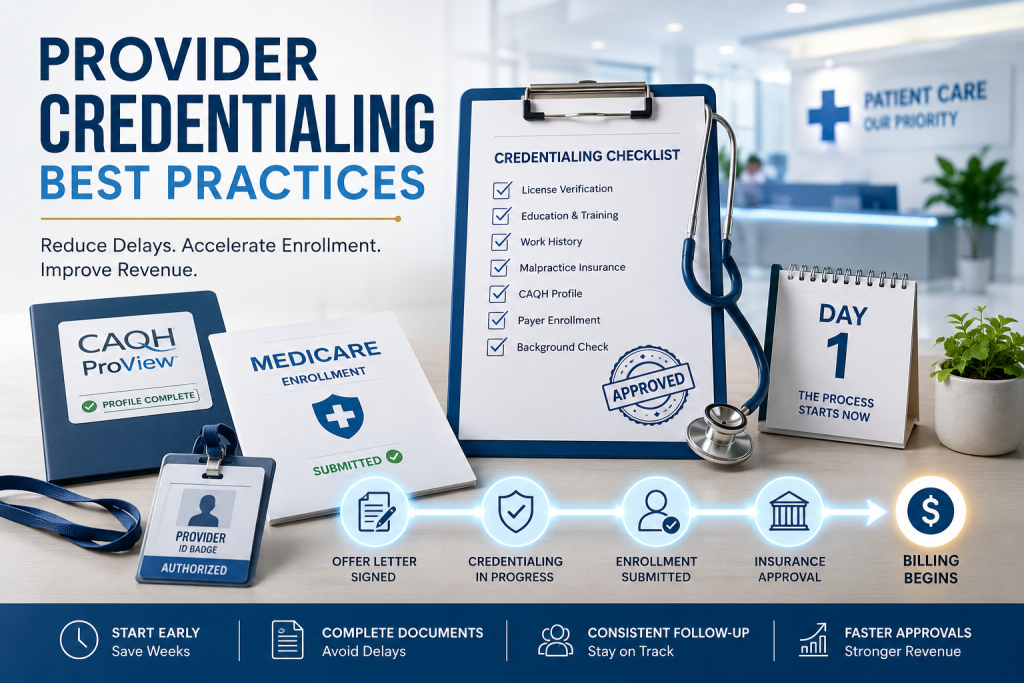
A new provider signs their offer letter, clears their background check, and shows up ready to see patients on day one , except they can’t bill for a single visit yet. Somewhere between the signature and the first paycheck, a stack of applications, verifications, and payer reviews has to move through a system that doesn’t care how excited everyone is to get started. This is the reality of provider credentialing and enrollment, and it’s one of the most underestimated risks to a healthcare practice’s revenue cycle. Getting this right isn’t just paperwork hygiene. It’s the difference between a provider seeing patients and generating revenue from week one, or a practice absorbing months of delayed reimbursement while a new hire sits on the sidelines of the billing system. Key Takeaways What Is Provider Credentialing, Exactly? Credentialing is the process of verifying a provider’s qualifications: education, training, licensure, work history, and any disciplinary history. Enrollment is the separate step of registering that provider with specific payers , Medicare, Medicaid, and commercial insurance plans , so claims can actually be paid. Practices often use “credentialing” as shorthand for both, but understanding the split matters, because a provider can be fully credentialed and still unable to bill a payer they haven’t enrolled with yet. This distinction is exactly why a structured approach to provider enrollment matters as much as the credentialing itself. Skipping ahead on one without finishing the other is a common source of denied claims. Why Timelines Matter More Than Most Practices Expect Delays here aren’t abstract. According to MGMA’s analysis of the credentialing process, it can take 90 to 180 days between submission of a provider’s application and final credential verification and approval. For a practice bringing on a new physician or nurse practitioner, that’s potentially half a year of a fully staffed, fully trained provider unable to generate reimbursable revenue through most payers. You’ve probably felt this if you’ve ever managed onboarding: the provider is present, the schedule is filling up, and yet claims are piling up in a “pending credentialing” bucket that nobody wants to look at too closely. The 5 Best Practices That Actually Move the Needle Most credentialing advice repeats the same generic checklist. Here’s the version that focuses on what actually prevents delays: A Simple Framework for Reducing Delays Practice When It Helps Most A Simple Cue Common Mistake Early document collection New provider onboarding Request documents the day the offer is signed Waiting until the start date to begin paperwork CAQH profile accuracy Before any payer submission Re-attest every 120 days without exception Letting the profile lapse or go stale Medicare-first sequencing Multi-payer enrollment Submit PECOS application before commercial plans Submitting commercial and Medicare applications out of sync Centralized tracking Practices onboarding multiple providers One shared tracker for every application’s status Relying on individual staff memory or scattered emails Scheduled payer follow-up Long-pending applications Check in weekly, not only when a denial appears Waiting passively for payers to respond What Should You Prepare Before You Even Start? Here’s the direct answer: a complete, verified document package speeds up nearly every stage of both credentialing and enrollment. At minimum, that means: Gaps or inconsistencies in any of these are among the most common reasons applications get returned for correction, which resets the clock on an already long process. Myths vs. Facts About Credentialing and Enrollment Myth: “Credentialing and enrollment are the same process.” Fact: Credentialing verifies a provider’s qualifications; enrollment registers them with specific payers so claims can be reimbursed. A provider can be credentialed and still not enrolled with a given plan. Myth: “Once CAQH is done, the process is basically finished.” Fact: CAQH completion is one input into payer review, not an approval itself. Commercial payers, Medicare, and Medicaid each still conduct their own separate review and approval process. Myth: “Outsourcing credentialing is only worth it for large practices.” Fact: Smaller practices often lose more, proportionally, to delayed reimbursement and denied claims from in-house credentialing gaps than they would spend on a dedicated credentialing solution. Do this, not that: Do treat credentialing as a parallel track that starts on day one of employment. Don’t treat it as a formality to handle after the provider already has a full patient schedule. A Familiar Scenario Picture a growing multi-specialty practice bringing on two new providers in the same month. The front office is focused on scheduling, onboarding, and EHR access , understandably so. Credentialing gets handed to whoever has time between other tasks, and CAQH profiles sit half-finished for weeks. By the time applications go out, Medicare and three commercial payers are all moving on different timelines, with no single person tracking which payer is waiting on which document. Three months later, both providers are seeing full patient loads, but a growing stack of claims sits unpaid, waiting on enrollment that should have started the day their offer letters were signed. This is less a rare mishap than a pattern that shows up in practices without a dedicated credentialing solutions process , which is exactly the gap that a structured credentialing and enrollment partner is built to close. Bringing It Together As management theorist W. Edwards Deming put it, “If you can’t describe what you are doing as a process, you don’t know what you’re doing.” Credentialing and enrollment reward exactly that mindset , a defined process, tracked consistently, beats scrambling reactively every time. The practices that treat this as a structured workflow, starting the day an offer letter is signed, consistently see shorter timelines and fewer denied claims than those that treat it as an afterthought. If your practice is bringing on new providers, or finding that credentialing keeps eating into staff time better spent elsewhere, it may be worth having a dedicated team handle it. Easy Billing Services’ credentialing solutions cover provider enrollment, CAQH setup and maintenance, licensing, NPI registration, and hospital privilege applications for all provider types in all states , built specifically to keep this process from becoming the bottleneck it
Outsource Credentialing Services: What It Means and Why So Many Practices Are Making the Switch
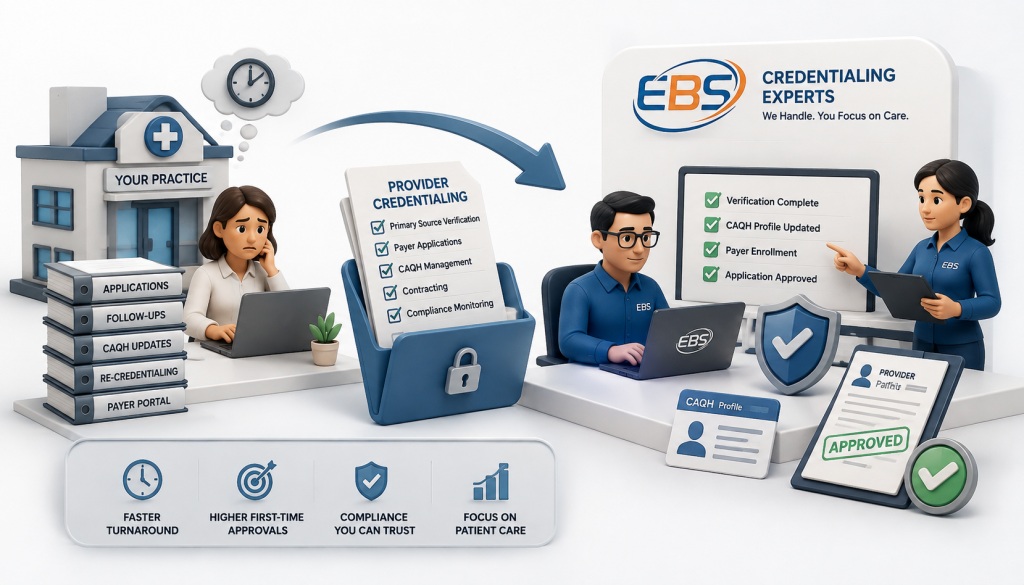
A hospital administrator once described her credentialing workload like juggling with one hand tied behind her back , fifteen providers, six payer panels each, and a spreadsheet that only she fully understood. When she went on medical leave for two weeks, three re-credentialing deadlines slipped through unnoticed. The fix wasn’t a better spreadsheet. It was recognizing that credentialing had outgrown what any single in-house employee could reliably manage alone. That’s the exact realization driving more practices and hospitals to outsource credentialing services every year. Key Takeaways What Does It Mean to Outsource Credentialing Services? Outsourcing credentialing means partnering with a specialized company that handles the entire process on your behalf , primary source verification, payer applications, CAQH profile management, follow-up calls, and ongoing re-credentialing. Rather than managing every payer application internally, your practice hands that workload to a team that does this daily, across hundreds of providers and payer relationships. This is different from simply buying credentialing software. A software platform gives you tracking tools, but someone still has to do the actual work of submitting applications and following up with payers. Full-service medical credentialing solutions include that labor, not just the dashboard. Why Practices and Hospitals Are Outsourcing Credentialing The case for outsourcing comes down to speed, accuracy, and freeing up internal staff for higher-value work: Who Actually Benefits From Outsourcing Credentialing? Outsourcing isn’t just for large systems , it scales down just as well as it scales up: What’s Included in Full-Service Credentialing and Enrollment Services Service Component What It Covers Initial credentialing Primary source verification, license checks, background and malpractice history review Provider enrollment Payer-specific applications for Medicare, Medicaid, and commercial insurers CAQH management Profile setup, ongoing attestation, and data accuracy checks Contracting support Negotiating and managing payer contracts as part of credentialing and contracting services Compliance monitoring Exclusion list checks, license expiration tracking, and re-credentialing scheduling Status reporting Regular updates so your team always knows where each application stands The Fastest Way to Get Professional Credentialing Services Set Up Do This, Not That: Getting Outsourcing Right A Familiar Scenario: The Group Practice That Stopped Firefighting Overview: A seven-provider multi-specialty group had one office manager handling credentialing alongside a dozen other responsibilities, using little more than a shared spreadsheet to track deadlines. What happened: Insight: As Henry Ford once put it, “coming together is a beginning, staying together is progress, working together is success.” Outsourcing credentialing isn’t about giving up control , it’s about partnering with a team built specifically to keep the process moving. Finding the Right Credentialing Partner for Your Practice Among the many credentialing and enrollment services available, the right fit depends on your provider count, specialties, and payer mix. Easy Billing Services offers full credentialing solutions , including Medicare and Medicaid enrollment, CAQH management, commercial payer credentialing, contracting support, and DME-specific accreditation , built for solo practices, growing groups, and larger organizations alike. Ready to hand off the paperwork? Call Easy Billing Services at (877) 306-2906 or email info@easybillingservices.com to talk through your credentialing needs. Frequently Asked Questions What does it mean to outsource credentialing services? It means partnering with a specialized company to handle the full credentialing process , verification, payer applications, CAQH management, and ongoing compliance , instead of managing it with internal staff. What are the best credentialing services for a growing practice? The best fit depends on your provider count and payer mix, but look for a partner with strong first-time approval rates, transparent pricing, and experience with your specific specialties. Is Easy Billing Services a hospital credentialing company, or just for smaller practices? Easy Billing Services supports practices of every size, from solo providers to larger, multi-provider organizations with more complex payer and contracting needs. What’s included in provider enrollment and credentialing services? Typically primary source verification, payer-specific enrollment applications, CAQH profile management, contracting support, and ongoing compliance monitoring. How is medical billing and credentialing services different from credentialing alone? Combining both means the same partner manages provider enrollment and the billing process together, which helps prevent the revenue gaps that happen when enrollment and billing are handled separately. What’s the fastest way to get professional credentialing services for a new hire? Start the process as early as possible , ideally 90 to 120 days before a provider’s start date , and hand off documentation and CAQH access right away so verification isn’t delayed by missing paperwork. Do outsourced credentialing companies handle re-credentialing too? Yes, ongoing re-credentialing and compliance monitoring are typically included as part of full-service credentialing and enrollment services, not just the initial application.
How to Select the Best Credentialing Company for Your Practice
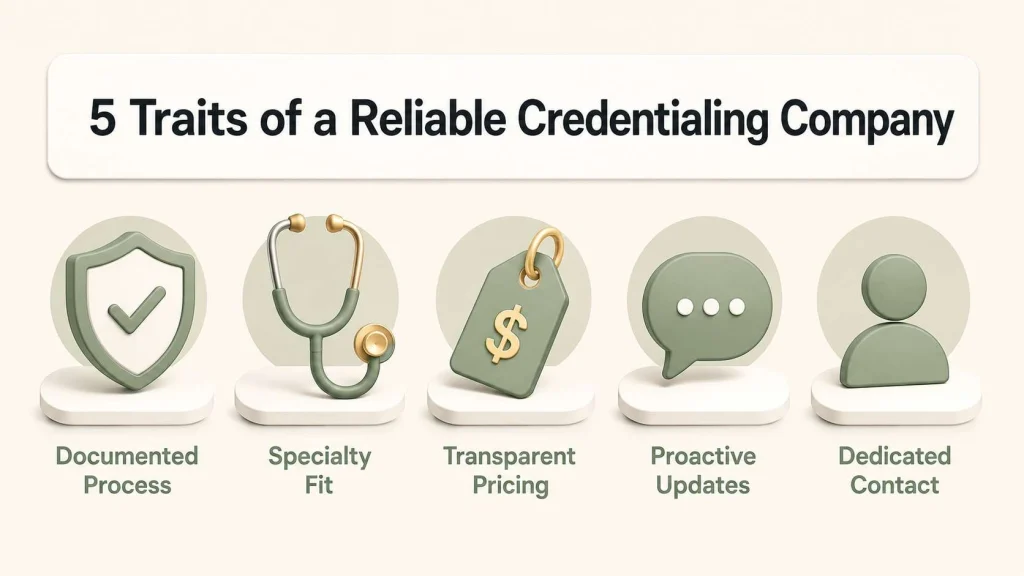
Imagine two clinics hiring their first nurse practitioner in the same month. One clinic picks a credentialing partner based on a fast phone call and a low quote. The other spends an extra week asking the right questions before signing anything. Ninety days later, one provider is seeing insured patients and generating revenue. The other is still stuck in a payer queue, and nobody can explain why. That gap didn’t come down to luck. It came down to how each clinic selected its credentialing company. Choosing a credentialing partner feels like a back-office decision, but it behaves like a revenue decision. The right company gets providers approved and billing sooner. The wrong one creates delays that are hard to trace and even harder to fix once they’ve already cost you weeks of reimbursement. Key Takeaways Why the Credentialing Company You Pick Actually Matters Credentialing determines when a provider can start billing insurance. Pick a company that’s disorganized, slow to communicate, or unfamiliar with your specialty, and every one of those problems becomes your practice’s problem , usually in the form of delayed reimbursements and frustrated new hires. It also matters more than it used to. Credentialing oversight tightened significantly in 2025, when the National Committee for Quality Assurance (NCQA) shortened its primary source verification window from 180 days to 120 days for accredited organizations, and to 90 days for certified ones, specifically to keep provider data current and get practitioners into networks faster. A credentialing partner that hasn’t adjusted its workflow to these tighter standards is already operating behind the current bar. (source) What Actually Separates a Good Credentialing Company From a Mediocre One A credentialing company’s job sounds simple: verify a provider’s qualifications and get them approved with payers. In practice, that job involves dozens of moving pieces , CAQH profile management, payer-specific application requirements, primary source verification, and relentless follow-up. The companies that do it well share a handful of traits that are easy to check for before you sign anything. In-House Team, Software Platform, or Full-Service Company: How Do They Compare? (Figures below are general guidance for planning purposes; actual fit depends on your practice size and growth pace.) Approach What You Get Best Fit For Watch Out For In-house credentialing staff Full control, direct oversight Larger groups hiring providers regularly Salary, training, and turnover costs Credentialing software only Tracking dashboards and reminders Practices that already have staff to do the work Software still requires someone to execute the process Full-service credentialing company End-to-end handling, from documents to payer approval Growing practices, multi-payer panels, DME and Medicare enrollment Confirm exactly what’s included before signing Delegated / NCQA-certified CVO Verified process aligned to national standards Organizations that need audit-ready compliance Fewer providers offer true delegated credentialing Is a Slower, Cheaper Option Ever the Right Call? Sometimes. A solo provider joining two payers with plenty of admin time might not need a full-service partner. But as soon as a practice is hiring regularly, working across several payers, or managing Medicare, Medicaid, and commercial credentialing at once, the value of a documented, accountable process starts to outweigh the appeal of the lowest quote. As Warren Buffett once put it, “it takes 20 years to build a reputation and five minutes to ruin it” , and few processes put a practice’s reputation and cash flow at risk faster than an unreliable credentialing partner. Choosing based on trust and track record, not just price, tends to hold up better over time. The Five-Question Framework for Vetting Any Credentialing Company Before signing with any credentialing partner, ask these five questions directly: A Simple Checklist for Comparing Your Top Two or Three Options Do This, Not That: Common Mistakes When Choosing a Credentialing Partner A Familiar Scenario: The Clinic That Switched Credentialing Partners Mid-Process Overview: A three-provider clinic hired a credentialing company based on the lowest quote they received, without checking accreditation status or asking for specialty references. What happened: The turnaround: Insight: The lowest quote wasn’t actually the cheapest option once six weeks of stalled revenue were factored in , the clinic paid for the switch, but paid far more for the delay that made it necessary. Making the Final Call Selecting a credentialing company comes down to matching your practice’s size, specialty, and growth pace with a partner that has a documented process, relevant experience, and communication you can count on. Price matters, but it shouldn’t be the deciding factor on its own , a slightly higher fee from a reliable, NCQA-aligned partner is almost always cheaper than months of stalled reimbursements from an unreliable one. For practices weighing this decision, Easy Billing Services offers full credentialing solutions covering Medicare and Medicaid enrollment through PECOS, commercial payer credentialing, CAQH setup and attestation, NPI registration, hospital privilege applications, and DME-specific accreditation , all handled with a dedicated team rather than a rotating inbox. Before your next hire starts the clock, it’s worth confirming exactly who will be handling their credentialing and how. Ready to talk through your options? Call Easy Billing Services at (877) 306-2906 or email info@easybillingservices.com for a straightforward conversation about your practice’s credentialing needs. Frequently Asked Questions How can Easy Billing Services help me choose the right credentialing approach? Easy Billing Services works directly with practices to handle Medicare, Medicaid, commercial payer, and DME credentialing, offering a dedicated team and clear, itemized pricing so you know exactly what’s included from the start. Does Easy Billing Services handle credentialing for specialties beyond DME? Yes. Their team supports provider enrollment, CAQH management, NPI registration, and hospital privileging across a range of specialties and provider types, not only DME. How do I select the best credentialing company for my practice? Look for NCQA accreditation or certification, direct experience with your specialty, a transparent and itemized fee structure, and a dedicated point of contact who provides regular updates. Is NCQA accreditation necessary for a credentialing company? It isn’t legally required, but it’s one of the clearest signs a company follows a documented, monitored,
How Much Does Credentialing Cost? A Clear Breakdown for Healthcare Practices

Picture a nurse practitioner who just joined a busy family practice. Her license is active. Her malpractice coverage is signed. Her schedule is already filling up. But two months later, she’s still seeing only a trickle of patients, because her insurance paperwork hasn’t cleared yet. Every day she waits, real revenue quietly walks out the door. That’s the hidden weight behind one deceptively simple question: how much does credentialing cost? It sounds like it should have a one-line answer. It doesn’t. The number depends on how many payers you’re joining, what kind of provider you’re credentialing, and whether you handle the paperwork yourself or hand it to someone who does this every day. But once you understand the moving parts, the cost stops feeling like a mystery and starts feeling like something you can actually plan for. Key Takeaways What Credentialing Actually Is (In Plain Terms) Credentialing is the process of proving a provider is who they say they are and qualified to do the job. Insurance companies, hospitals, and government programs verify a provider’s education, licenses, work history, and malpractice record before they’ll allow that provider to bill them. No credentialing, no reimbursement ,it’s really that direct. Behind that one-sentence definition sits a stack of paperwork: CAQH profile setup, license verification, background checks, malpractice history, and a separate application for every single payer a provider wants to join. Multiply that by however many insurance panels your practice works with, and you can start to see why the cost question doesn’t have a flat answer. How Much Does Credentialing Cost? For a single provider joining a single insurance payer, professional credentialing services typically charge between $200 and $500. That fee covers gathering documentation, submitting the application, and following up until the provider is approved. Add every payer a provider needs ,several commercial plans plus Medicare and Medicaid ,and most practices end up spending somewhere between $2,000 and $5,000 per provider in the first year, once setup fees, CAQH management, and follow-up work are included. That range moves depending on three things: how many payers you’re enrolling with, how complex the provider’s specialty is, and whether a practice handles the process in-house or brings in outside help. A solo behavioral health provider joining three payers pays very differently than a multi-specialty group onboarding five new physicians at once. What Pushes Credentialing Costs Higher or Lower? A few variables explain almost all of the swing between a modest bill and an expensive one: A Quick Look at Typical Costs by Approach (Figures below are general ranges for planning purposes; your actual cost will depend on your state, specialty, and payer mix.) Approach Typical Cost Range Best Fit For Where Costs Sneak Up Handling it yourself Staff time worth roughly $750–$1,500+ per provider, plus payer fees Very small practices with spare admin hours Missed deadlines and resubmissions Professional credentialing service Roughly $200–$500 per payer, or $2,000–$3,000+ per year per provider for full service Growing practices with multiple payers Setup fees and ongoing CAQH upkeep Full-time in-house specialist $50,000–$80,000+ in annual salary and benefits Larger groups hiring providers regularly Turnover, training, and slow seasons with underused staff Hospital privileging $500–$1,500+ per provider, separate from payer enrollment Providers who need hospital privileges Assuming it’s bundled into payer credentialing when it isn’t In-House vs. Outsourced Credentialing: Which One Actually Costs More? On paper, doing credentialing in-house looks like the cheaper option, because there’s no vendor invoice. In practice, a single application can take four to eight hours to complete correctly, and a provider joining five or more payers can easily consume 20-plus staff hours between paperwork, follow-up calls, and fixing small errors that trigger a rejection. Multiply that by an office manager’s hourly rate, and the “free” option often costs more than a flat-fee service ,without the benefit of someone who already knows exactly what each payer wants to see. Outsourcing shifts that cost from unpredictable staff hours into a fixed, plannable number. It also tends to shorten the waiting period, which matters more than most owners expect. As Benjamin Franklin put it, “By failing to prepare, you are preparing to fail” ,and few processes reward preparation the way credentialing does. The Four Levers That Really Control Your Credentialing Bill Instead of thinking of credentialing as one flat fee, it helps to think of it as four levers you can actually pull: A Simple Way to Budget for Credentialing Before You’re Surprised by It Do This, Not That: Mistakes That Quietly Inflate the Bill The cost of getting this wrong is bigger than most practices expect. According to the Medical Group Management Association, a 2019 Merritt Hawkins survey found that a one-day delay in provider onboarding can cost a medical group over $10,000 ,a reminder that the real expense of credentialing usually isn’t the application fee at all. It’s the revenue that never gets billed while paperwork sits in a queue. (source) A Familiar Scenario: The New Provider Who Almost Cost Two Months of Revenue Overview: A small multi-provider clinic hired a new physician assistant, expecting her to start seeing patients within two weeks of her official hire date. Nobody had started the payer applications until her first day. What happened: The turnaround: Insight: The clinic didn’t pay more for credentialing help ,it paid for the two months of lost billing that happened before it asked for help. Is Paying for Professional Credentialing Support Worth It? For a solo provider joining two or three payers, doing it yourself might genuinely make sense. But for practices onboarding providers regularly, working across multiple payer panels, or managing Medicare, Medicaid, and DME enrollment at the same time, the math tends to favor outside support ,not because it’s cheaper on the invoice, but because it protects the revenue that would otherwise sit in limbo. That’s the exact gap Easy Billing Services was built to close. Beyond DME and Medicare billing, their team handles Medicare, Medicaid, and commercial provider enrollment, CAQH setup and attestation, NPI registration, hospital privilege applications, and